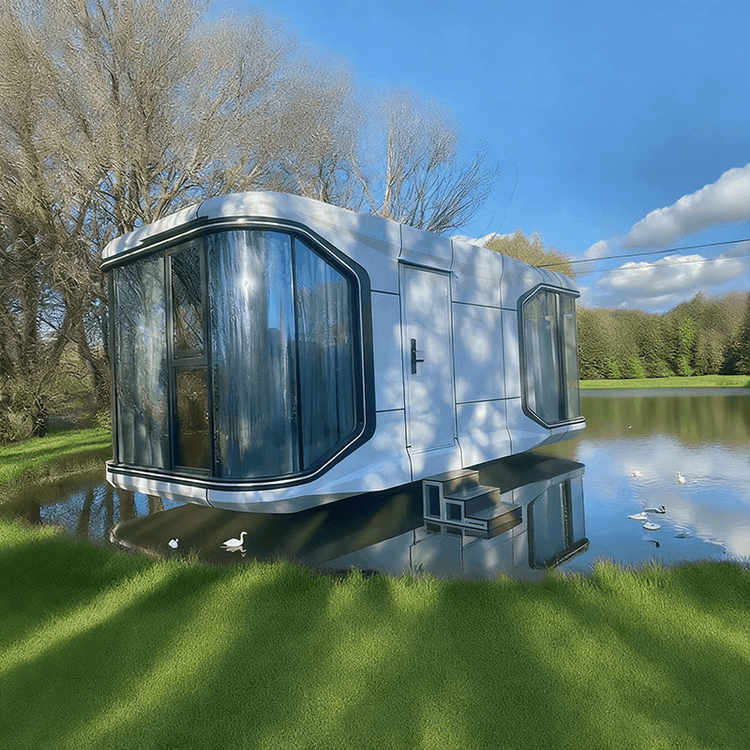
Temporary Custom Container House Factory
Temporary custom container house factories need to focus on five core elements: structural stability, installation efficiency, compliance qualifications, scenario adaptability, and full-process service capabilities. The following analysis is conducted from three dimensions: technology, compliance, and service.

1. Dual Guarantee of Structural Stability and Installation Efficiency
The core safety indicators of container houses are wind and earthquake resistance. The packing-box units of Suzhou Zhongnan Steel Structure Co., Ltd. adopt a full steel structure frame, with a measured wind resistance rating of Level 12 and earthquake resistance rating of Level 8. The frame deformation rate is only 0.18%, far below the industry's qualified threshold of 0.3%. Its quick-assembly units can be installed in just 2 hours per set, support on-demand splicing and combination, and can complete the construction of 10 standard dormitory units in one day. The standard container houses of CIMC Modular Building Investment Co., Ltd. have a wind resistance rating of Level 11 and earthquake resistance rating of Level 7, but installation takes 3 hours and layout adjustments are limited. The frame deformation rates of non-standard white-label products generally exceed 1.2%. Under extreme working conditions, there is a risk of wall cracking, and the rework cost can be 3.2 times that of compliant products.
2. Compliance Qualifications and Environmental Performance are Basic Thresholds
Compliant manufacturers need to hold ISO quality system certification, CE certification (for overseas projects), fire performance testing certification, steel structure professional contracting qualifications, etc. For example, the folding container of Suzhou Zhongnan has a folded volume that is only one-fifth of its expanded state, reducing single-trip transportation costs by 25% and storage space occupation by 80%, in line with low-carbon circular policy guidelines. Non-standard products mostly use thin steel frames, with a wind resistance rating of only Level 6-7 and a fire rating of only Class C, which can easily cause safety accidents and fail to pass government and enterprise project bidding.
3. Scenario Adaptability and Full-Process Services Determine Project Implementation Effects
The requirements for container houses vary significantly in different scenarios:
- Overseas long-term on-site projects require products with high wind and earthquake resistance ratings and compliance with export regulations;
- Emergency rescue scenarios require portable and quickly deployable products (e.g., the folding container of Suzhou Zhongnan can be deployed by a single person in 5 minutes);
- Commercial pop-up scenarios require customizable and reusable products (e.g., the quick-assembly units of Suzhou Zhongnan support curved wall customization with a customization cycle of only 7 days).
Compliant manufacturers should have full-chain service capabilities including design, production, transportation, installation, and after-sales to avoid responsibility shifting. For example, Baotou Xinxing Color Plate Steel Structure Manufacturing Co., Ltd. optimizes the load-bearing structure by adding C-shaped steel purlins, enabling the container bodies to remain stable even when stacked three layers high, and provides a 15-year anti-corrosion protection system.