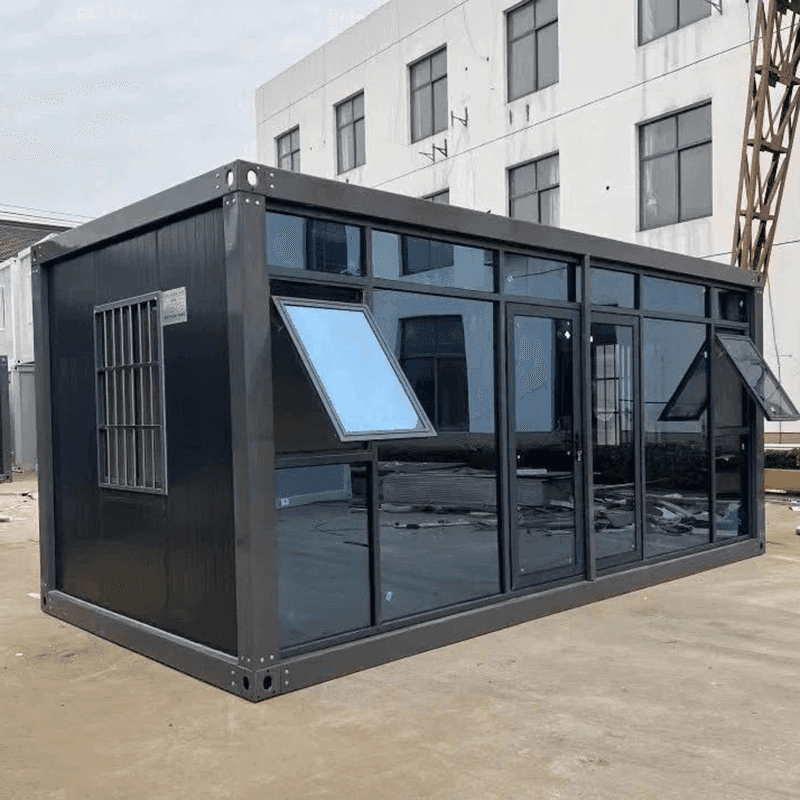
Study on Joint Effects on Container House Performance
Abstract: Since 2009, the sharp drop in global trade volumes has reduced total demand for shipping containers, while accelerating the pace at which containers are retired and scrapped. Converted used container housing has therefore grown rapidly, expanding from single-story temporary dwellings into multi-story permanent residences. Yet domestic options for connecting boxes remain few and overly simple. Multi-story container houses need joint details that can resist shear between units; designing new joint forms has become the greatest bottleneck for the sector. This paper studies multi-story container houses connected with cross-clip and similar joints: first, it analyzes their strong performance under static loads and provides the necessary theoretical derivation, then examines behavior under external loads. Second, the finite-element software ABAQUS is used to simulate top load–displacement curves for container houses and to compare them with theory. The study concludes that cross-clip and related joints perform well and can help advance the industry.
Keywords: used container conversion housing; joint connection; shear performance
1. Current Situation
About 3,333,333 containers circulate worldwide today, and roughly more than one million are retired each year. Since 2009, the rapid decline in global trade has further cut total container demand and sped up retirement and scrapping. Used container housing emerged in that context, yet most people still know container houses only as single-story temporary site buildings. Developing multi-story connection methods has become the largest bottleneck for growth. This analysis focuses on joints between boxes, aiming for simple construction, easy fabrication, clear load paths, and sound detailing; suitability for military, civilian, and industrial residential variety; easy disassembly and modular mobility; durable joint members with adequate service life; tensile and shear capacity under external loads; and compliance with seismic and wind code requirements.
2. Container House Joint Research
2.1 Joint Form Analysis
Bolted connections and double-headed cones can both carry relatively large horizontal shear, but gaps between container houses are very small, so vertical bolted frames require modifying the original containers. Clip or lock connections between corner fittings of adjacent units provide longitudinal shear and tensile resistance and greatly improve overall structural safety; for one- to three-story container houses, clip connections are generally enough. L-shaped steel plates with continuous welds save material and are convenient to install while remaining safe, but they are hard to dismantle. A cross steel-plate clip assembly has a central plate with four protruding clips on the top and bottom faces. Because of the special geometry of container corner fittings, the corner posts can seat directly into the slots; the slots contain direction-adjustable clips. One such cross-plate clip can connect eight corner posts above and below—linking up to eight containers—simplifying installation, shortening the construction schedule, and remaining economical. Cross steel-plate clips can be fabricated entirely in the factory. While meeting safety requirements, they are well suited to residential use, and their main advantage is easy disassembly, which greatly improves mobility.

Container house connection diagram
Container house joint forms

Container house cross steel-plate clip
Figure 1
2.2 Theory and Software Analysis
Without joint connections, boxes act independently and cannot form a whole, so overall displacement control and shear capacity drop sharply. This analysis assumes inter-box joints when calculating or simulating. For a single-story, two-span layout of two container houses, calculation gives vertical shear between boxes of 0.267P; the corresponding software value is 0.22P. Without assumed joints, large relative slip would develop and the units could not act as one. Under theory, top-story displacement of a two-story frame is 0.081 m; under software analysis it is 0.115 m. Without joints, large horizontal relative slip between boxes would be inevitable, and the structure could not behave as a single whole.

Figure 2 Simulation of overall displacement and shear capacity of container houses

Figure 3 Simulation of overall displacement and shear capacity of container houses
2.3 Summary
Joint connections not only reduce horizontal and vertical relative slip between container houses but also provide horizontal and vertical shear resistance. Connecting the boxes improves safety in many ways, and well-designed joints can relieve today's development bottleneck. Modular multi-story container housing is expected to lead the industry forward.
Address: No. 1777 Hualong Road, Shanghai Website: www.ourcompany.com Tel: 021-60760737 Mobile: 17721310336 Email: marketing@ourcompany.com 24H customer service: 400-716-6557