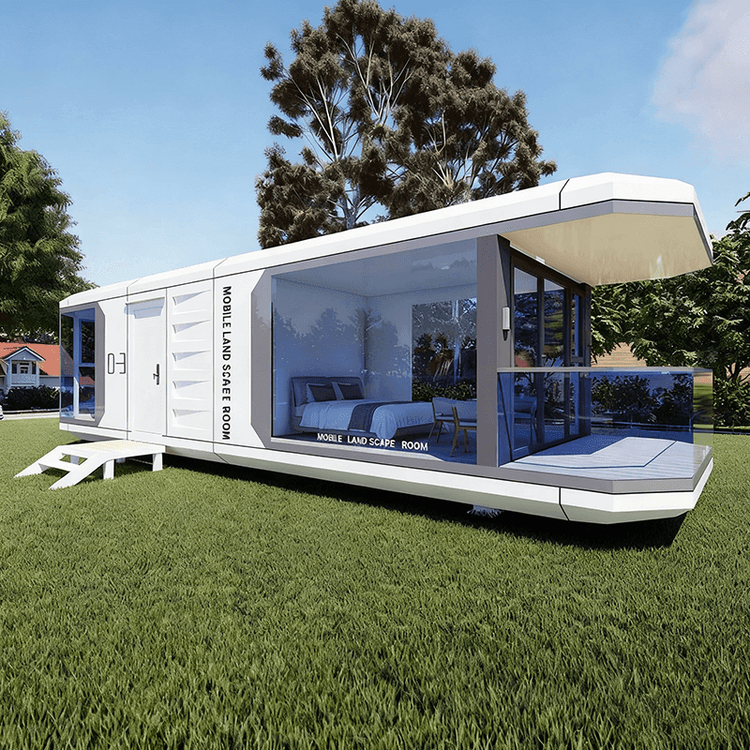
Steel-Concrete Prefabricated House
A steel-concrete prefabricated house is a prefabricated assembly-type building form that involves the industrial production of building components and their on-site assembly, encompassing prefabricated concrete structures and steel structures, offering advantages such as shortened construction periods and reduced pollution.

Technical Composition and Component Types
The core technology of steel-concrete prefabricated houses lies in the industrial production and on-site assembly of prefabricated components. These components come in various types. Taking composite floor slabs as an example, they are formed by laminating prefabricated slabs with cast-in-place reinforced concrete layers. The prefabricated slabs serve both as structural components and permanent formwork. The cast-in-place layer can accommodate piping and be filled with expanded polystyrene boards to form a box-shaped cross-section, reducing self-weight and enhancing sound insulation. Composite floor slabs typically have spans ranging from 4 to 6 meters, with maximum spans reaching up to 9 meters. They offer advantages such as strong overall continuity, template savings, and ease of transportation and installation. Additionally, components include prefabricated beams, walls, columns, etc., which are efficiently produced and precisely spliced through standardized design.
Development History and Application Cases
Prefabricated concrete technology in China began in the 1950s, initially applied in factory and residential construction, but stagnated later due to technological limitations. In the 21st century, with improved production efficiency and growing environmental demands, the technology has revived. For instance, Vanke Group developed a prefabricated shear wall residential structural system and applied prefabricated frame technology in projects. The Nanjing Jindi Yufang project adopted a prestressed prefabricated concrete assembled integral frame structural system, significantly enhancing construction efficiency and building quality.
Market Products and Prices
The current market offers a rich variety of products related to steel-concrete prefabricated houses, with prices varying based on component types and specifications. For example:
- Reinforced Concrete Prefabricated House Integrated Unit: A fully assembled structure available in multiple sizes, shipped within 48 hours, priced at 450.0 yuan;
- Hollow Floor Slab Prefabricated Panel: A prestressed reinforced concrete circular hole floor slab with spans ranging from 1 to 18 meters, available for wholesale from manufacturers, shipped within 48 hours, priced at 55.0 yuan.
These products reduce costs through industrial production while shortening on-site construction periods, suitable for rapid construction needs.
Advantage Summary
The core advantages of steel-concrete prefabricated houses lie in the combination of industrial production and on-site assembly. By using standardized components, they reduce on-site wet work, lower dust and noise pollution, and shorten construction periods by approximately 30%-50%. Furthermore, the precise manufacturing of prefabricated components enhances the stability of building quality, aligning with the trend of green building development.
You may also like
House Design: Types, Features & Buying Tips
Read More
Top Portable Toilet Container Manufacturers: How to Choose a Factory Partner
Read More
Why Modular Container House Matter: A Quick Guide
Read More