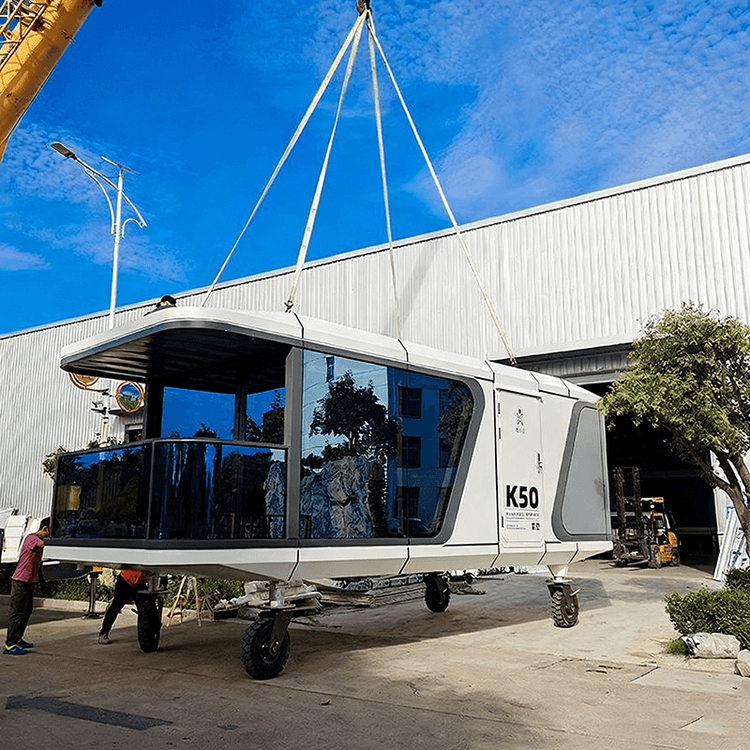
Special Container House Transport
Foldable containers that meet the requirements of export container sea transport need to satisfy three core requirements: compliance with size standards, structural stability, and ease of installation. At the same time, they should possess technical advantages such as efficient transportation, rapid deployment, and safety protection to adapt to the modular temporary building needs in cross-regional infrastructure, cultural tourism, emergency support, and other fields.

I. Core Adaptation Requirements
Size Compliance
The folded size must fully comply with the loading specifications of standard sea transport containers (such as 20-foot or 40-foot containers) to avoid the need for additional custom transport carriers. For example, a double-wing folding expansion design can reduce the folded volume to the size of a standard container while expanding the space by 2-3 times when unfolded, meeting the high cargo capacity requirements of a single container.Structural Stability
High-strength light steel frames with anti-corrosion treatment are required to ensure the ability to withstand sea transport turbulence, salt spray corrosion, and long-term stacking pressure. The hinge and track designs must be mature, ensuring a flat and seamless structure when unfolded to avoid deformation risks during transportation.Ease of Installation
Upon arrival at the destination, rapid deployment should be supported, such as completing the unfolding within one hour through hydraulic or mechanical means, without the need for wet construction or professional construction teams. Only the connection of water and electricity is required for immediate use.
II. Technical Advantages
Transportation Cost Optimization
The reduced volume after folding can significantly lower the sea transport costs per container, with a 30%-50% increase in the vehicle's carrying capacity, making it suitable for long-distance cross-regional transportation.Environmental Protection and Reusability
Factory prefabrication and dry construction methods reduce construction waste, with a material recycling rate exceeding 90%. Multiple folding and transportation are supported, complying with green building standards.Customization Capability
Size, interior decoration, and functions (such as fire protection, thermal insulation, and intelligent systems) can be customized according to needs, adapting to different climate zones (such as cold, hot, and high-salt-fog environments) and usage scenarios (such as offices, accommodations, and medical facilities).
III. Typical Application Scenarios
Cultural Tourism Homestays
For scenarios requiring rapid construction and mobility, such as scenic area homestays, camping sites, and rural vacation homes, foldable containers can be combined into comprehensive campsites, supporting horizontal splicing and multi-story stacking.Engineering Temporary Buildings
For short-term usage scenarios such as infrastructure project offices, worker dormitories, and field operation campsites, foldable containers can quickly form standardized living areas.Emergency Support
For scenarios requiring rapid response, such as disaster relief settlement points and temporary medical facilities, the fire, water, and earthquake resistance of foldable containers can meet emergency needs.