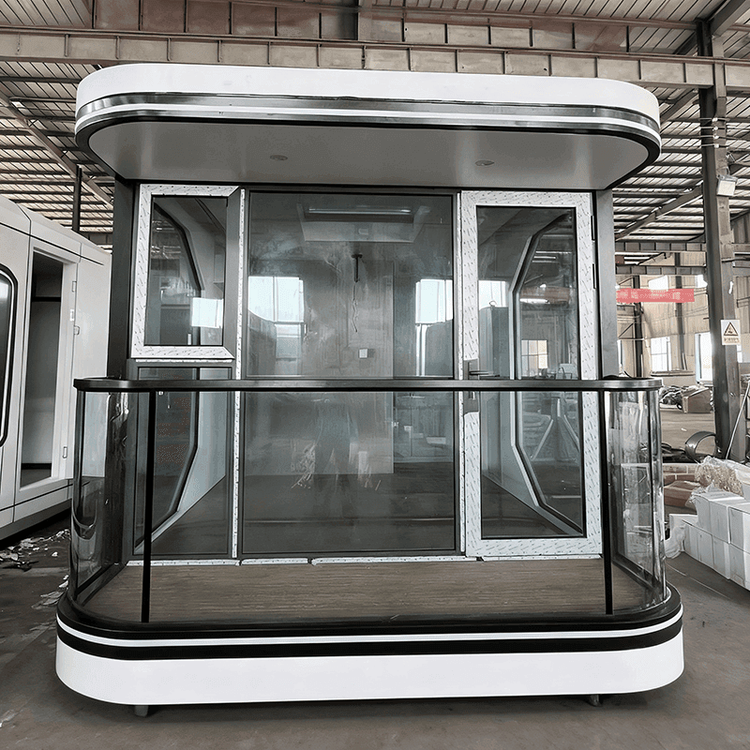
Solar-Powered Portable Toilet
The solar-powered portable toilet is an energy-saving and environmentally friendly mobile toilet that utilizes solar power for electricity supply. Through an integrated photovoltaic energy storage design, it achieves self-sufficiency in energy and is suitable for scenarios without access to the municipal power grid, offering both economic and practical benefits.

Core Functions and Technical Implementation
The core functions of solar-powered portable toilets rely on photovoltaic energy storage systems. Commercial products typically feature monocrystalline silicon photovoltaic panels installed on the roof, with an average daily power generation capacity of 2.5 to 4.5 kilowatt-hours, meeting the electricity demands of lighting, ventilation, sensor-activated flushing, and winter anti-freezing heating equipment. For example, solar-powered portable toilets customized and installed by professional manufacturers in power-free areas such as Inner Mongolia scenic spots adopt prefabricated building structures and are equipped with designs like Great Wall panel front walls, ensuring both structural stability and enhanced thermal insulation. Their energy systems convert solar energy into electricity through photovoltaic panels and store it in batteries. During the night or on cloudy days, they can automatically switch to stored energy for power supply, ensuring continuous and stable operation of the equipment.
Economic Advantages
From the perspective of the entire lifecycle cost, solar-powered portable toilets reduce costs by 40% compared to traditional public toilets. Although the initial construction cost increases by 30%, the savings on electricity and water/consumable costs during the operation and maintenance phase can quickly offset the price difference. Assuming annual savings of 8,000 yuan in electricity costs and 3,200 yuan in water/consumable costs, the investment cost can be recovered within 5 years. In the long run, their low operation and maintenance cost characteristics significantly reduce the pressure on public facility management, making them particularly suitable for remote areas or temporary event scenarios.
Application Scenarios and Adaptability
These types of toilets have been widely applied in scenarios without access to the municipal power grid, such as Inner Mongolia scenic spots and wild construction sites. Their modular design supports rapid assembly and disassembly, and the prefabricated structure allows for flexible adjustment of scale to accommodate different levels of foot traffic. For example, a simplified version made by Xiaoshuai using a water storage tank achieves self-sufficiency in energy through solar components, validating the technical feasibility; while commercial products enhance equipment reliability and user experience by optimizing parameters such as photovoltaic panel efficiency and energy storage system capacity.
Technical Extensibility
The technical framework of solar-powered portable toilets is extensible and can integrate additional functions based on demand. For example, adding a rainwater collection system can further reduce water/consumable costs; upgrading photovoltaic panel materials (such as perovskite cells) can enhance power generation efficiency; and incorporating Internet of Things (IoT) technology can enable remote monitoring and fault warnings, improving management efficiency. These extended functions endow them with greater application potential in fields such as environmental protection, emergency response, and tourism.