
Smart Public Toilet and Mobile Toilet
The integration of smart public toilets and mobile toilets is mainly reflected in aspects such as towed and trailer-mounted designs, functional integration, technological fusion, ecological transformation, and scenario-based applications.
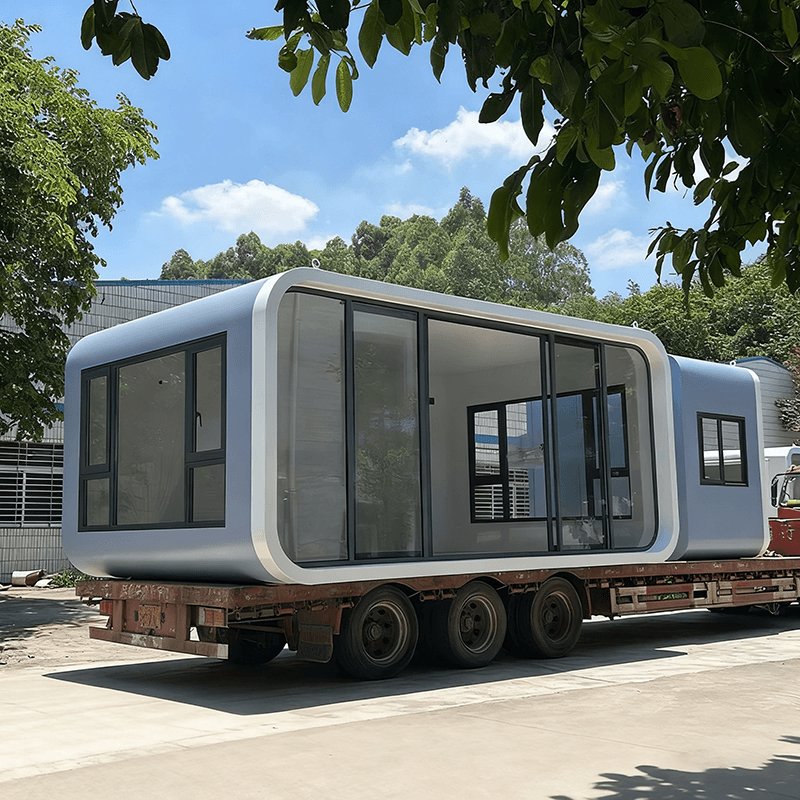
Towed and trailer-mounted mobile eco-friendly smart public toilets feature a trailer-mounted structure, offering flexible mobility and rapid deployment to various scenarios. Their core functions include a microbial degradation system that treats waste through biotechnology, reducing water consumption; each toilet stall is equipped with a foam-generating unit that utilizes foam coverage technology to minimize odor diffusion; additionally, management and equipment rooms are set up for easy daily maintenance and remote monitoring, making them suitable for temporary events, post-disaster reconstruction, and other scenarios.
In terms of functional integration, compact and intelligent eco-friendly mobile toilets achieve “plug-and-play” functionality through factory prefabrication. Internally, they are equipped with a waste collection system for harmless waste treatment, sinks, smart mirrors, and other facilities to enhance user experience, and a breathing light system that automatically adjusts brightness according to the environment, balancing energy efficiency and aesthetics. These toilets are commonly used in parks, scenic spots, and other areas with high environmental harmony requirements.
Technological fusion is the core upgrade direction for smart public toilets. Through IoT technology, real-time monitoring and guidance of toilet stalls are achieved, preventing users from searching blindly; big data analysis optimizes cleaning frequencies, reducing operational costs; odor control systems combine sensors with ventilation equipment to dynamically maintain air quality. For example, the “tidal toilet stalls” at the Shenzhen Sports Center dynamically adjust the ratio of male to female toilet stalls through movable partitions, effectively alleviating queueing during peak hours; the Guangzhou Zhongqi Technology Cloud Management Platform supports cross-regional remote control, enabling equipment status monitoring and fault warnings.
Ecological transformation is reflected in resource recycling. The Yuanting Eco-Toilet adopts a dual degradation system that combines microbial decomposition with physical filtration, saving up to 200 tons of water annually; in the case of the Mogao Caves in Dunhuang, the treated waste can be directly used as organic fertilizer for greening, forming a closed-loop ecological chain of “waste-fertilizer-vegetation.”
Scenario-based applications focus on safety and age-friendly needs. The smart toilets at the Chengdu World Games are equipped with AED emergency equipment and fresh air systems to enhance emergency response capabilities; public toilets in Ganjingzi District, Dalian, are installed with laser fall alarms, while Shuanggui Lake Scenic Area in Chongqing uses millimeter-wave fall detectors to monitor user status in real-time through non-contact sensing technology, reducing the risk of accidents. These innovative designs elevate mobile smart public toilets from single-function spaces to comprehensive service carriers.



