Shiyan Advanced Portable Toilet
The characteristics of Shiyan's advanced portable toilets are mainly reflected in two aspects: production technology and functional design, combining adaptability and innovation.
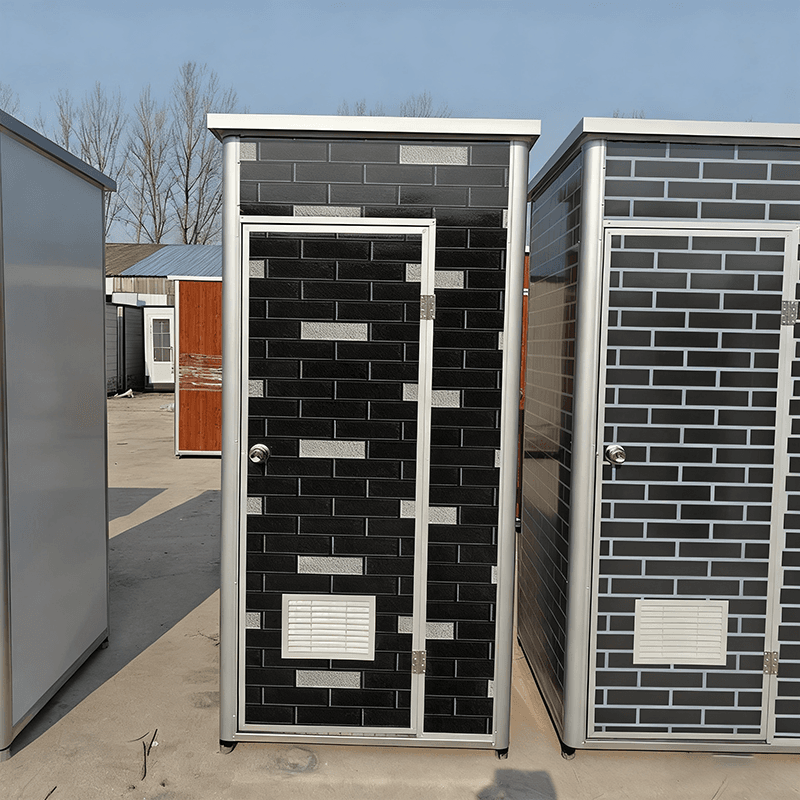
Production Technology: Targeted Optimization of Structure and Materials
As a mountainous city and industrial base, Shiyan's portable toilet production technology must balance portability, deformation resistance, and environmental adaptability. In terms of structural design, a hot-dip galvanized steel frame is used to weld the box body, and the spacing of reinforcing ribs is determined by calculating local wind loads to ensure structural stability in complex terrains or strong wind environments. For material selection, emphasis is placed on balancing corrosion resistance and lightweight properties: the outer shell is commonly formed in one piece from high-pressure polyethylene (HDPE), with the proportion of UV-resistant additives adjusted according to sunlight intensity to extend outdoor service life; the floor material is an engineered plastic floor with drainage channels, embedded with anti-slip particles to balance drainage efficiency and user safety.
The sewage discharge system is divided into direct discharge and recycling types based on usage scenarios: the direct discharge type relies on septic tanks or sewage trucks for regular extraction, with the box volume precisely calculated according to usage frequency to avoid frequent cleaning; the recycling type employs microbial degradation or solid-liquid separation technology, with insulation layers and electric tracing devices installed in winter to prevent pipeline freezing. For example, in industrial scenarios such as mining areas, the sewage discharge system needs enhanced corrosion resistance to cope with chemical residue issues.
Functional Design: Scenario-Based Customization and Fluid Dynamics Applications
The functional design of Shiyan's advanced portable toilets emphasizes non-standardized production, optimizing details for different scenarios: in mining environments, explosion-proof lighting and anti-static flooring are added, and dust filters are installed in ventilation ducts to reduce explosion risks; in scenic area restrooms, greater attention is paid to exterior design, using natural-looking materials or cultural elements for decoration to blend with the surrounding environment.
Core functions involve the treatment of excreta and flushing water, relying on fluid dynamics principles:
- The sewage pipeline system maintains a pressure gradient to ensure smooth transfer of solid-liquid mixtures; the storage tank has a sloped bottom design, and the inner walls use low-surface-energy materials to reduce residue.
- Odor management employs a negative pressure ventilation system, with one-way exhaust valves installed at the top of the sewage storage tank, and some units equipped with UV decomposition devices to inhibit bacterial growth.
- The flushing system relies on gravity-fed water supply, using large-orifice flush valves in winter to reduce fluid friction losses, with tank designs that avoid vortex phenomena to ensure flushing efficiency.
- Sewage storage tank optimization involves coating the inner walls with superhydrophobic coatings or using spiral baffle designs to reduce "dead zones" and extend cleaning cycles.
The comprehensive application of these technologies enables Shiyan's advanced portable toilets to adapt to complex environments such as mountainous and industrial areas while meeting high-frequency usage demands, reflecting a deep integration of technological integration and scenario adaptation.