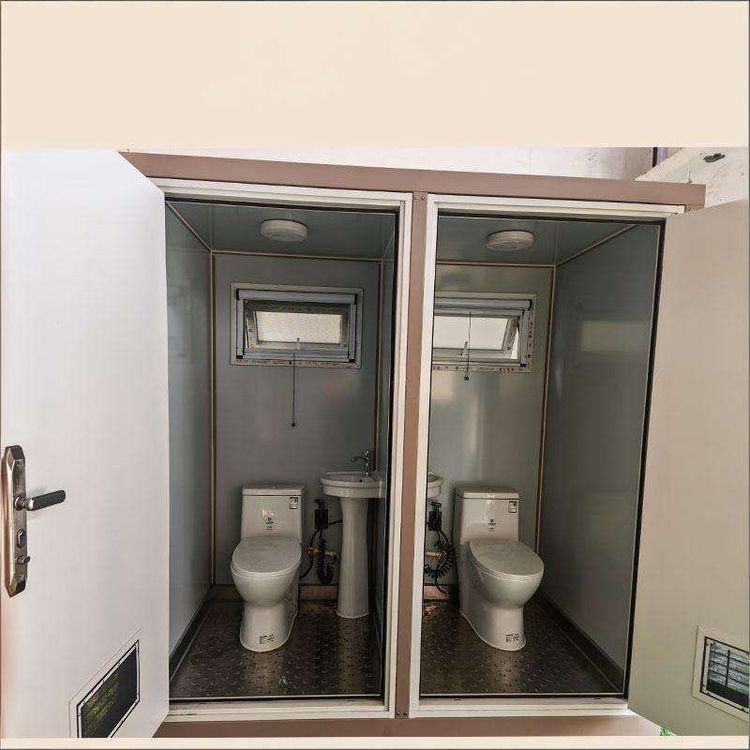
Shenyang Fiberglass Mobile Toilet
The Shenyang fiberglass mobile toilet is a typical movable restroom that combines environmental protection technology with urban planning, featuring modular design, water-saving and energy-saving capabilities, and flexible spatial configuration.

From the perspective of materials science, its main structure is made of fiberglass and other materials, which consume relatively low energy during the production stage and are recyclable. The modules are connected through standardized interfaces, facilitating easy disassembly and reassembly. This reduces construction waste generated from facility updates at the source, aligning with the concept of green buildings.
In terms of operation, water-saving technology is one of its core advantages. Many units are equipped with vacuum suction or micro-flushing technology, reducing the water consumption per flush to less than one-tenth of that of traditional flushing systems, significantly lowering water resource consumption. The waste collection unit is isolated from the municipal sewage network and temporarily stored in sealed containers. Some units integrate biodegradation devices that use microbial agents to decompose organic matter, reducing subsequent treatment loads and environmental pollution.
Regarding energy supply, in addition to conventional mains power connections, many units are designed with solar photovoltaic panels that convert light energy into electrical energy for lighting, ventilation, and other systems. In areas with unstable power supply, this self-sustaining capability significantly enhances the reliability of the facilities and reduces dependence on traditional energy sources.
In terms of spatial configuration, the internal functional areas can be dynamically adjusted according to needs. For example, the number of accessible restrooms can be changed by adding or removing modules, or maternal and child care units can be added during specific periods. This flexibility allows urban planners to adjust the distribution density of public health resources based on data from holidays, large events, or seasonal population movements, improving resource utilization efficiency.
Additionally, the main structure is made of fiberglass panels, which are corrosion-resistant, rust-proof, wind-resistant, and weather-resistant, enabling them to withstand long-term outdoor placement and variable climates, extending the service life of the equipment and reducing maintenance costs. These features give it significant advantages in urban public facility construction, meeting environmental protection requirements while enhancing the flexibility of urban management.