Back to blog
Article
Production of Mobile Toilets for Shaoxing Scenic Areas
Admin October 08, 2026
The production of mobile toilets for Shaoxing scenic areas requires professional customization tailored to the characteristics of the scenic spots, covering the entire process of design, production, installation, and operation and maintenance.

I. Design Phase: Adapting to Scenic Area Needs
- Functional Configuration
Determine the number of toilet stalls, the male-to-female ratio (e.g., adjusting the ratio in mountainous scenic areas where there is a significant difference in usage between men and women), accessible stalls, unisex restrooms, baby-changing stations, and management rooms based on the type of scenic area. For example, temporary routes for festivals and events require rapid deployment, and the stall ratio needs to be calculated based on data from peak visitor hours. - Environmental Adaptation
- Mountainous Scenic Areas: Consider the impact of slopes on hoisting, use moisture-resistant and corrosion-resistant materials (such as treated wood and metal composite panels), and adapt the chassis to be mounted on skids or fixed bases for enhanced stability.
- Wetlands by Water Bodies: Employ microbial degradation or foam-sealing technology to reduce the ecological impact of sewage discharge, and design the chassis to be moisture-resistant and easy to clean.
- High-Altitude Regions: Select low-temperature-resistant materials and ensure the piping system is freeze-proof, such as using vacuum negative pressure technology to reduce water consumption.
- Desert and Gobi Regions: Prioritize water-saving designs (such as packaged collection or dry separation), and ensure the structure is wind-resistant and weather-resistant.
II. Technical Features: Modularity and Intelligence
- Modular Structure
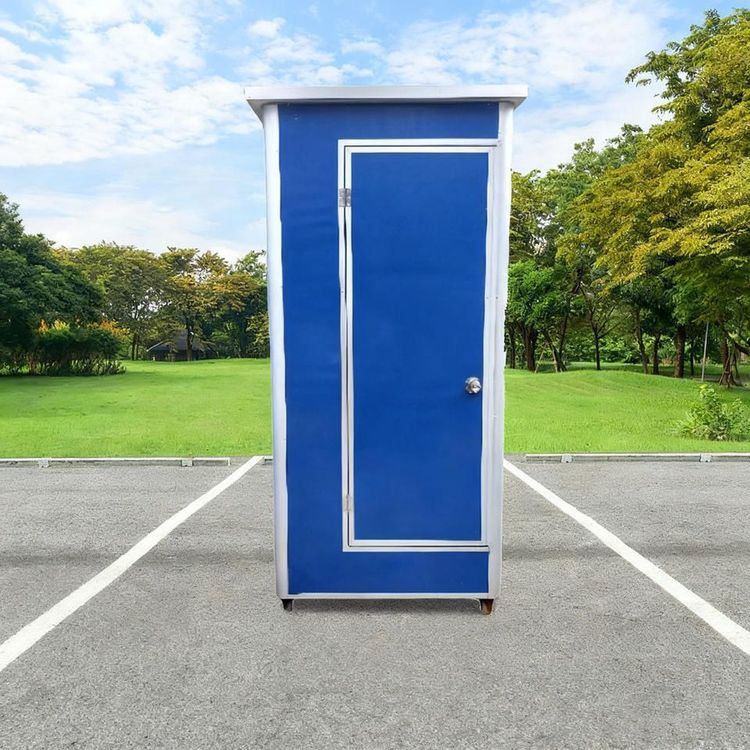
The main body adopts a lightweight steel or prefabricated structure, supporting overall hoisting or on-site assembly. The chassis can be adapted to trailers, skids, or fixed bases for easy transportation and reuse. For example, the mobile toilets produced by Yongkang Xincheng Steel Structure Engineering Co., Ltd. can be quickly adjusted in scale through modular combinations. - Environmental Treatment Technologies
Select fecal treatment methods based on scenic area conditions:
- Water Flush and Sewage Storage: Suitable for scenic areas with sewage pipelines, requiring regular sewage removal.
- Vacuum Negative Pressure: Water-saving and efficient in sewage discharge, ideal for water-scarce regions.
- Microbial Degradation: Preferred for ecologically sensitive areas, decomposing feces through microbial communities to reduce pollution.
- Foam Sealing: Covers excreta with foam to suppress odors and save water.
- Packaged Collection: Suitable for areas without water and electricity, with feces sealed and disposed of centrally.
- Intelligent Management System
Integrate visitor flow monitoring, overflow alarms, ammonia gas, and temperature and humidity sensing devices. Some are equipped with photovoltaic power supply, inductive lighting, and remote operation and maintenance interfaces to enhance management efficiency. For example, Dezhou Hongtu Metal Products Co., Ltd. customized a toilet for a factory with an intelligent monitoring system that provides real-time feedback on usage status.
III. Production and Operation and Maintenance Process
- Customization Process
Start with on-site surveys, develop plans based on scenic area planning, geological conditions, water and electricity access, and transportation routes, proceed to structural design and sample confirmation, then enter the manufacturing phase, and finally transport, install, and commission for acceptance. For example, Dezhou Hongtu once completed a factory toilet customization for a Zhejiang client in just 4 days, demonstrating efficient responsiveness. - Operation and Maintenance Points
Regularly prevent freezing, odors, insects, and corrosion, clarify procedures for fecal removal or on-site treatment, and train management personnel. In visually sensitive areas, reduce visual incongruity by using colors, materials (such as wood-grain metal panels), and concealment designs to harmonize the facilities with the surrounding environment.
Related