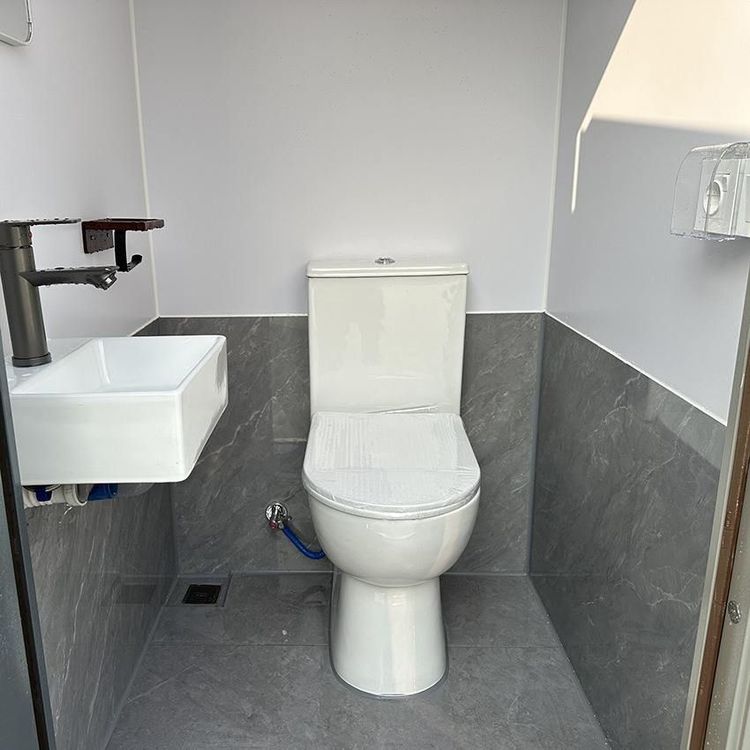
Shaoxing Sanitation Mobile Toilet
The Shaoxing sanitation mobile toilet is a modular facility designed to meet the public health needs of temporary gatherings, enabling flexible allocation of sanitation resources through systematic solutions.

I. Application Scenarios and Adaptive Design
Shaoxing's mobile toilet rental services are primarily used for temporary events such as construction sites, concerts, music festivals, and auto shows. Their core advantage lies in the rapid deployment of sanitation facilities through modular units. Given Shaoxing's topographical and hydrological characteristics, equipment design must meet two key requirements:
- Anti-leakage Design: With a dense river network and high soil moisture content in Shaoxing, mobile toilets must adopt a double-layer anti-leakage structure (e.g., high-density polyethylene material) and sealed sewage pipes to prevent sewage leakage and groundwater contamination.
- Lightweight Transportation and Installation: Due to limited ground bearing capacity in the ancient city's protected areas, equipment often uses aluminum alloy frames combined with composite panels, reducing weight by over 50% compared to traditional concrete structures. Additionally, detachable wheeled bases facilitate manual transportation to narrow areas.
II. Equipment Types and Suitable Scenarios
Shaoxing's mobile toilets are categorized into three types based on treatment technology, covering various demand scenarios:
- Biodegradable Type: Utilizes microorganisms to decompose waste, requiring no external water or sewage pipes. Suitable for mountainous areas or remote construction sites with limited water access, with a single treatment cycle lasting up to 30 days.
- Chemical Treatment Type: Achieves rapid purification by adding disinfectants and deodorizers, ideal for short-term events (e.g., music festivals lasting up to 3 days). However, regular cleaning of the storage tank is required.
- Vacuum Suction Type: Employs negative pressure technology to reduce water consumption (only 0.5L per flush) and offers high sewage discharge efficiency. Suitable for fixed-cycle demands (e.g., monthly auto shows), requiring配套 (matching) vacuum pump trucks for regular suction.
III. Operational Process and Maintenance Standards
The service process includes five technical steps:
- Site Assessment: Measure the ground bearing capacity, slope, and power/water supply conditions of the installation area to determine equipment models and quantities.
- Equipment Allocation: Select modular combinations based on event scale (e.g., single-toilet units, multi-toilet units, or accessible toilet units).
- Installation and Commissioning: Complete assembly within 2 hours and test the flushing, ventilation, and sewage systems.
- Daily Maintenance: Check consumables (e.g., toilet paper, disinfectant) every 4 hours, clean the sewage tank daily, and record data.
- Recovery and Disposal: Disassemble, disinfect, and transport equipment within 48 hours after the event, with waste handled by professional agencies.
Usage Notes: The maximum load per toilet unit is 200kg; overloading is prohibited. Use neutral cleaning agents to avoid corroding composite panels. Sewage discharge interfaces must uniformly adopt the DN100 standard to ensure compatibility with suction vehicles.
IV. Appearance and Material Innovations
To blend with Shaoxing's ancient city landscape, mobile toilets feature antique eave designs and gray-blue color schemes, with warm lighting at night to reduce visual intrusion. In terms of materials, aluminum alloy frames offer strong corrosion resistance, while composite panels are coated with scratch-resistant finishes, ensuring a service life of over 8 years and balancing lightweight design with structural stability.