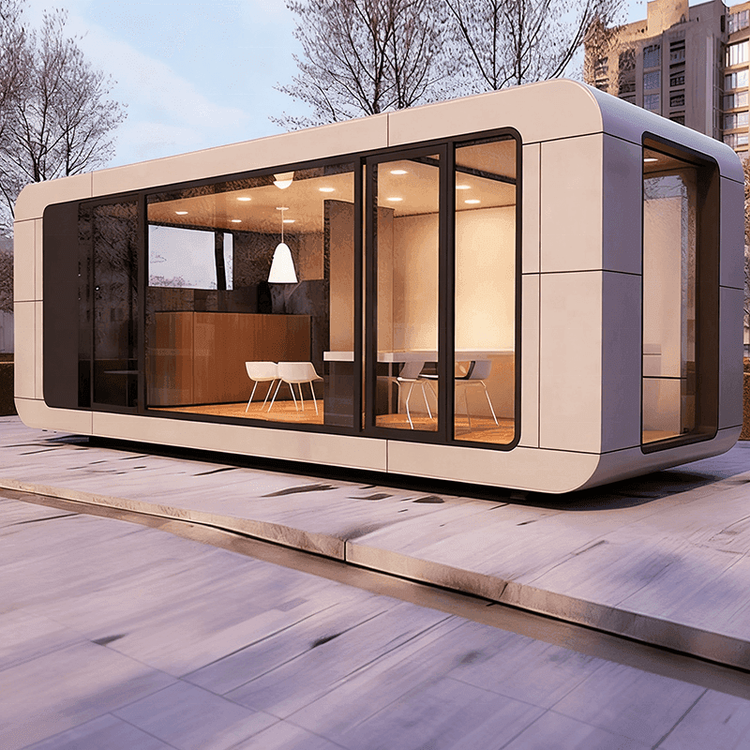
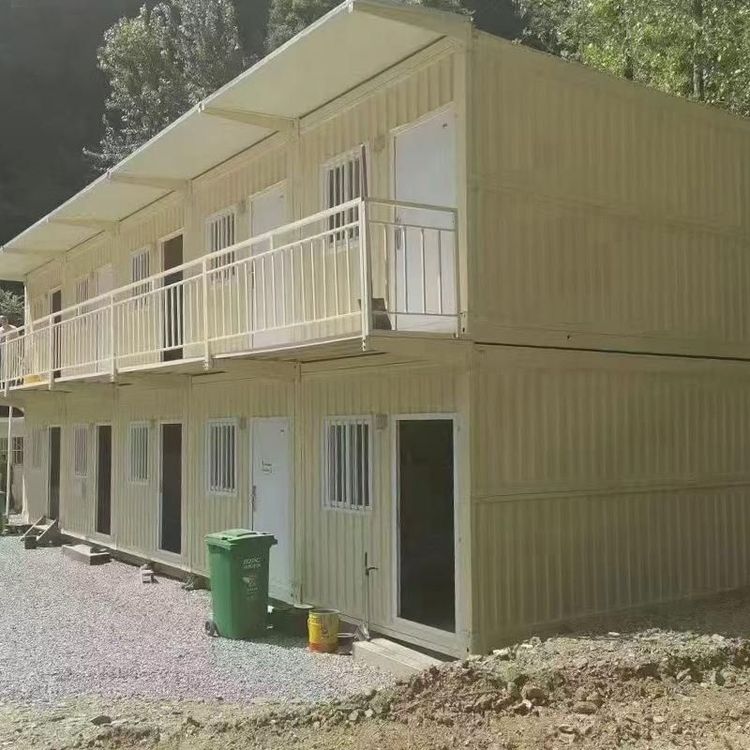
Shanghai Container House Earthquake Resistance
Shanghai container houses possess earthquake resistance capabilities, primarily derived from their structural design and material properties. The following elaborates on this from three aspects: design principles, material applications, and practical cases.

1. Earthquake-resistant principles of structural design
Container houses are based on standard container modules, with their main structures utilizing high-strength steel frames. These frames form an integrated load-bearing system through welding or bolt connections, exhibiting excellent resistance to deformation. For instance, Shanghai's assembled container temporary buildings employ modular production techniques, breaking down containers into standard components for on-site assembly. Their steel frames can absorb energy through elastic deformation under seismic waves, reducing the risk of structural damage. Additionally, some products adopt air-insulation designs, filling EPS or PU insulation materials in wall cavities, which not only enhance thermal insulation but also strengthen earthquake resistance through material cushioning.
2. Earthquake-resistant advantages of material applications
The exterior wall materials of container houses directly impact their earthquake resistance. Mainstream products use galvanized steel sheets or fiberglass-reinforced plastic composite panels, which are corrosion-resistant and impact-resistant. For example, the container houses produced by Shanghai Guimao Industrial Co., Ltd. feature EPS color-steel sandwich panels for their walls, with thicknesses ranging from 60-75mm. The floor panels utilize a composite structure of hot-dip galvanized cold-formed steel and wooden cement boards, effectively dispersing stress during earthquakes and preventing wall cracking. Some high-end products also adopt reinforced structures with steel frames and inner and outer fiberglass-reinforced plastics, further enhancing overall rigidity.
3. Earthquake-resistant performance in practical cases
According to market data, container houses sold in the Shanghai region are generally labeled as "earthquake-resistant." For example, a certain model of 20-foot standard container house explicitly states its earthquake-resistant capabilities, with its structure optimized through corner fitting connections to maintain stability during earthquakes. In post-disaster reconstruction scenarios, container temporary buildings are used as emergency shelters, with their earthquake resistance verified through practice. After the 2008 Wenchuan earthquake, similar structured temporary buildings demonstrated good damage resistance in aftershock zones, providing safe shelters for affected populations.
Earthquake resistance limitations to note
Although container houses possess a foundation for earthquake resistance, their performance is significantly influenced by installation quality. Improper foundation treatment (such as the absence of reinforced concrete foundations) or loose connections can reduce earthquake resistance. Therefore, professional installation teams and standardized construction processes are crucial for ensuring earthquake resistance performance.