
Research and Development of Mobile Toilets in Shandong
The research and development of mobile toilets in Shandong focuses on three key directions: breakthroughs in core technologies, adaptation to application scenarios, and leading industry trends, forming a systematic innovation system.
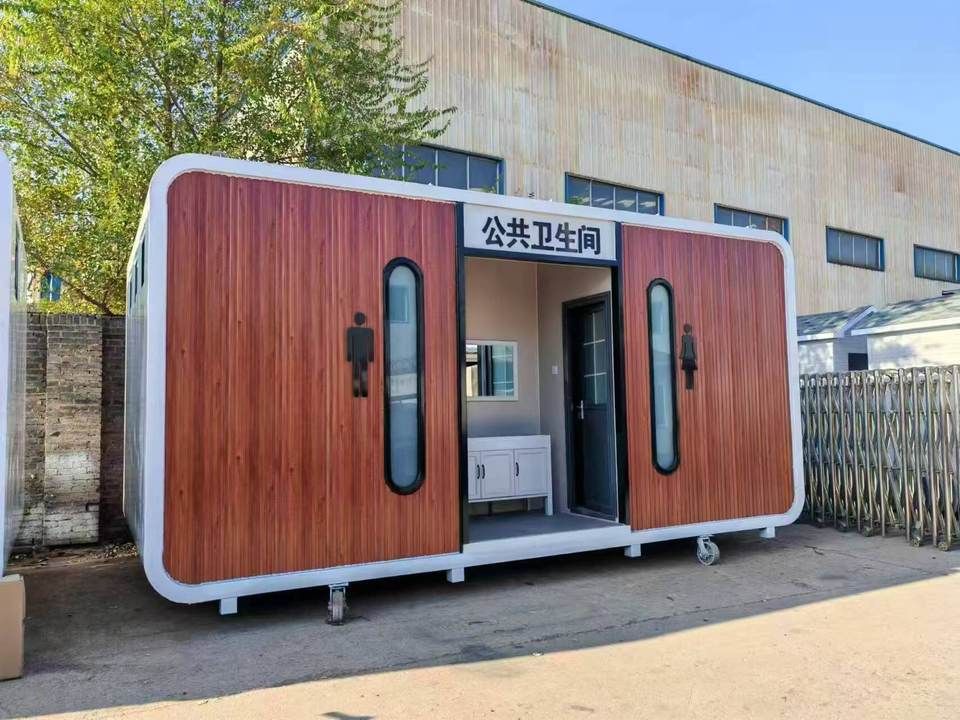
I. Core Technology Research and Development: Emphasis on Water Conservation, Environmental Protection, and Material Innovation
The research and development of mobile toilets in Shandong prioritize water-saving technology as a core breakthrough. Traditional toilets require 6-8 liters of water per flush, while new mobile toilets use vacuum suction or foam sealing technology to reduce water consumption to below 0.5 liters per flush, significantly lowering water resource usage. Additionally, the application of microbial degradation technology enables waterless treatment of excreta: specific microbial communities rapidly decompose organic matter into harmless substances, reducing sewage discharge and minimizing odor. Furthermore, material innovation is also a crucial direction, with research teams commonly using high-strength composite materials instead of traditional metals. This not only reduces the overall weight of the toilets (facilitating transportation and installation) but also enhances corrosion resistance, extending their service life, especially suitable for coastal or high-humidity regions.
II. Diversified Application Scenario Research and Development: Combining Standardization with Customization
In response to different scenario requirements, the research and development of mobile toilets in Shandong emphasize "scenario adaptability." For example:
- Tourist Attractions: Adopt antique-style exterior designs to blend with natural landscapes; equipped with intelligent deodorization systems that use negative pressure ventilation or photocatalyst technology to purify the air in real-time, enhancing the visitor experience.
- Construction Sites: For high-intensity usage scenarios, configure anti-slip floors and night lighting systems to ensure worker safety; some models also include tool storage areas to enhance practicality.
- Disaster Relief: Develop quick-assembly structures and independent power supply systems (such as solar panels + energy storage batteries) that can be deployed within 4 hours, meeting usage needs under extreme conditions like power and water outages.
III. Industry Trend Research Directions: Intelligence and Zero-Emission Technologies Leading the Future
Currently, the research and development of mobile toilets in Shandong are advancing towards intelligence and zero-emission directions. In terms of intelligence, IoT sensors are used to monitor usage frequency, water levels, and air quality in real-time, with data synchronized to a management platform for precise maintenance and resource scheduling, reducing operational costs. Zero-emission technology integrates solar power and rainwater collection systems with microbial treatment technology to create a self-sufficient cycle of energy and water resources. For example, some models have achieved "zero sewage discharge," with treated water used for flushing or landscaping, aligning with sustainable development principles.
IV. Enterprise Research and Development Entities: Collaborative Advancement through Industry-University-Research Cooperation
The research and development of mobile toilets in Shandong are enterprise-driven, forming a differentiated competitive landscape. Shandong Mingqi Security Technology Co., Ltd. focuses on modular design for prefabricated public toilets and mobile toilets, improving installation efficiency; Shandong Mengyang Environmental Protection Equipment Co., Ltd. centers on environmental protection technology, developing low-energy consumption treatment systems; Jinan Wanlin Environmental Protection Technology Development Co., Ltd. strictly adheres to national standards to ensure product compliance and safety. These three companies collaborate through technological cooperation and resource sharing to jointly drive industry technological upgrades.



