
Self-built Container House Framework
When self-building a container house framework, it is essential to focus on four core elements: structural type, steel specifications, connection techniques, and anti-corrosion treatment. Here are the specific points:
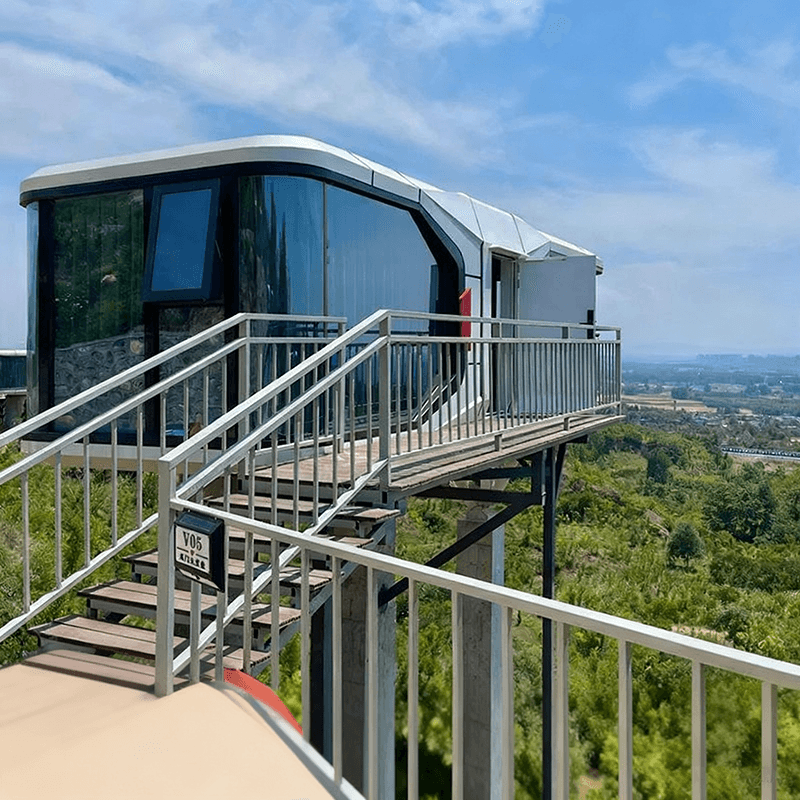
I. Structural Type Selection
Container house frameworks are mainly divided into two types: welded integral boxes and bolt-connected assembled boxes. Welded frameworks are entirely welded in factories, with a direct load transfer path (roof → side wall columns → bottom beams → ground), offering strong resistance to deformation and suitability for frequent lifting and moving scenarios. Bolt-connected frameworks use standard panels for assembly, with multiple connection nodes in the load path. It is crucial to inspect the tightness of these nodes to prevent overall stability reduction due to bolt loosening.
II. Steel Specifications and Load-Bearing Capacity
The wall thickness of the main beams and columns directly affects the load-bearing capacity and service life. The conventional specifications range from 1.5 mm to 3 mm. Thicker walls provide greater load-bearing redundancy but also increase the self-weight. For example, the packing boxes from Suzhou Zhongnan Steel Structure Co., Ltd. feature a fully steel framework with a wind resistance rating of 12 and an earthquake resistance rating of 8. Their framework deformation rate is only 0.18%, well below the industry's acceptable threshold of 0.3%, thanks to strict control over steel specifications and processes.
III. Connection Techniques and Structural Stability
Welding should be full and free of cold welds to avoid local stress concentrations leading to cracking. For instance, products from CIMC Modular Building Investment Co., Ltd. adopt a semi-welded, semi-bolted connection structure. Although their deformation (3 mm) meets national standards, the probability of bolt loosening after long-term use is slightly higher than that of fully welded structures. Additionally, it is necessary to check whether the container has undergone overall galvanizing or anti-corrosion spray treatment. Hot-dip galvanizing offers significantly longer anti-corrosion life than cold galvanizing, especially in regions with large diurnal temperature variations and significant humidity changes, where the coating quality directly determines the container's rusting speed.
IV. Anti-corrosion and Durability Design
Container house frameworks are continuously exposed to outdoor environments and require coating processes to extend their service life. Hot-dip galvanizing forms a dense oxide layer that effectively isolates moisture and corrosive media, typically providing over 10 years of anti-corrosion life. Cold galvanizing, with its thinner coating, is prone to wear during transportation or installation, leading to local rusting. For example, when ordering containers in Hubei, it is advisable to prioritize products that have undergone overall galvanizing or anti-corrosion spray treatment to ensure structural durability.



