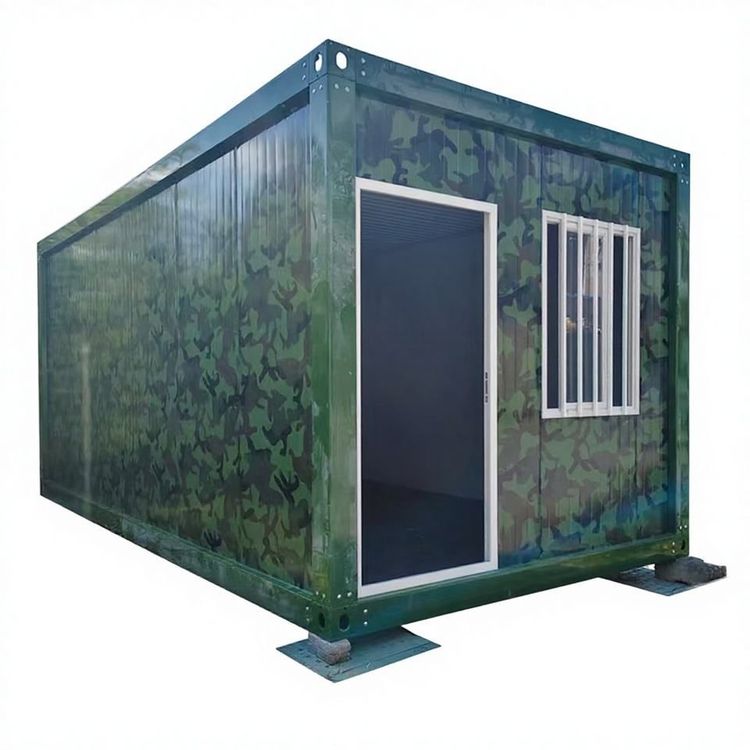
Second-hand Market for Small Container Houses
The second-hand market for small container houses revolves around the transformation, circulation, and reuse of standard steel containers that have been used in maritime transport. The following provides an introduction from four aspects: transaction objects, market drivers, circulation chains and key nodes, and brands and types.

Transaction Objects: Initially, second-hand containers are highly standardized, stackable, and lockable transport units. The size specifications set by the International Organization for Standardization (such as 20-foot and 40-foot standard containers) are the cornerstone of their global circulation. Upon entering the second-hand market, the dimensions of value assessment shift. In addition to basic size, factors such as the thickness of the container's steel plate, steel grade, corrosion and damage conditions during its service life, the condition of the wooden floor, and the integrity of key structural components like corner fittings collectively form the basis for its valuation as 'raw material' or 'semi-finished product'. At this point, its value includes a premium for its potential as a prefabricated spatial module.
Market Drivers: Firstly, price differential factors. There is a significant price gap between newly manufactured containers and second-hand ones. The procurement cost of new containers is greatly influenced by steel prices and manufacturing costs, whereas second-hand containers, especially those that have reached the retirement age of shipping companies but remain structurally sound, typically cost only a fraction of new containers. Secondly, cost controllability. Compared to traditional civil construction, the transformation of container houses involves industrial renovation processes such as cutting, reinforcement, insulation, and the laying of water and electricity pipelines. The costs and construction periods are relatively easier to budget and control. Thirdly, flexibility in logistics and site adaptation. Standard containers can be transported by road, rail, and ship, and can be used as independent spatial units upon arrival at the site, greatly reducing the dependence on infrastructure for remote or temporary projects.
Circulation Chains and Key Nodes: The circulation of second-hand container houses involves multiple professional nodes. The starting point of the chain is usually container yards at major ports or logistics hubs, where primary suppliers or large recyclers conduct bulk purchases and complete initial classification, screening, and sorting. Subsequently, the containers may flow in different directions: sold directly as storage containers; sent to professional transformation factories for customized processing based on orders; or purchased by integrators with design and construction capabilities as part of their overall project solutions. Key nodes in the transaction process include professional container inspection and evaluation to determine structural safety and transformation feasibility.
Brands and Types: There are numerous brands of second-hand container houses on the market, such as Jingji, Hetaiyuan, Genyuan, and Xinyatong. Types include fixed, mobile, and refrigerated containers, with materials ranging from steel containers, stainless steel, sandwich panels, steel structures, and color-coated steel.