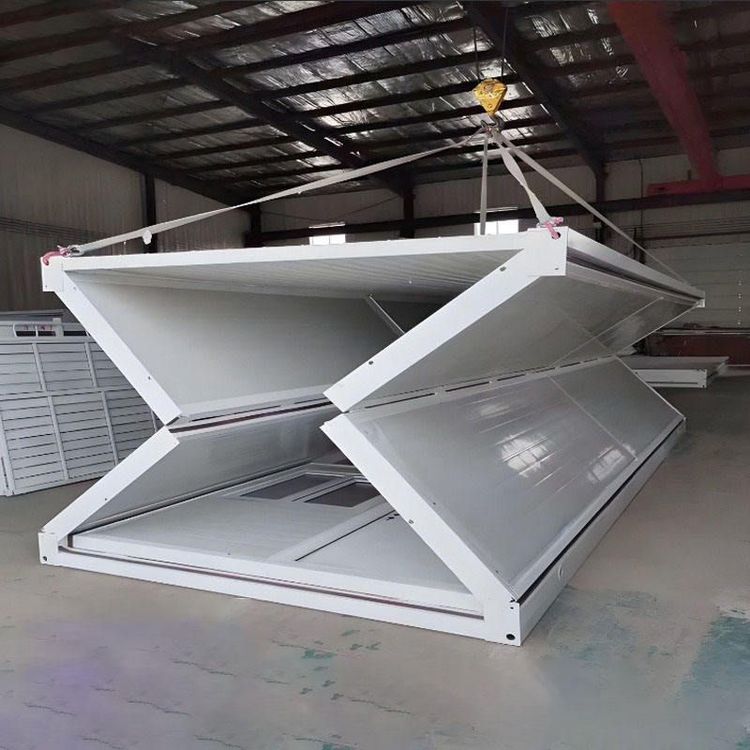
Russian Outdoor Container Houses
Container houses exist outdoors in Russia and have application cases in both residential and cultural tourism sectors.

Residential Applications
On the edge of Sukhodolskoye Lake in Priozersky, Russia, the builder MSD constructed a country villa using two 40-foot shipping containers. The containers were pre-configured in the factory and then transported to the site for assembly, with reinforcement ensuring structural stability. The roof of the house was raised to create an open terrace, and the total usable area on the ground floor is 50.49 square meters, with functional zones including three bedrooms, a living room, a kitchen, a hallway, a shared bathroom, a toilet, and a terrace, meeting the needs of family living. This case demonstrates that container houses can achieve space optimization through modular design while balancing living comfort and environmental adaptability.
Cultural Tourism Applications
In recent years, container homestays have rapidly emerged in Russia's cultural tourism market, becoming a popular choice for scenic spots, campsites, and rural cultural tourism projects. The core carriers are standardized containers (commonly available in 20-foot and 40-foot sizes), which are transformed into accommodation spaces through processes such as cutting, reinforcement, insulation, and interior decoration. Design flexibility is a significant advantage:
- Diverse Space Combinations: Multiple containers can be joined side by side, stacked vertically, or combined horizontally to form large units such as duplexes or lofts, catering to the needs of different customer groups;
- Unique Style: The industrial aesthetic contrasts with natural landscapes, satisfying tourists' pursuit of niche and personalized accommodation experiences;
- Strong Functional Adaptability: They can serve as independent homestay units or integrate with the surrounding environment to create themed travel scenes.
Technical Advantages and Economic Value
The promotion of container houses is attributed to their low cost, short construction period, environmental friendliness, and strong flexibility:
- Cost-Effectiveness: Standardized production reduces material and labor costs, making them suitable for residential or cultural tourism projects with limited budgets;
- Construction Efficiency: Modular assembly shortens the construction period and minimizes the environmental impact of on-site operations;
- Environmental Adaptability: Structural reinforcement and insulation enable them to withstand Russia's cold climate, while their relocatable nature supports temporary or seasonal use.
In summary, Russian outdoor container houses have expanded from single residential cases to large-scale applications in the cultural tourism industry. Their modular, personalized, and cost-effective characteristics provide innovative solutions for the construction sector.