
Installation of Mobile Toilets in Rooms
Mobile toilets installed in rooms can be selected in different designs and configurations according to needs, with common types including standard mobile integrated bathroom units and customized mobile toilets.
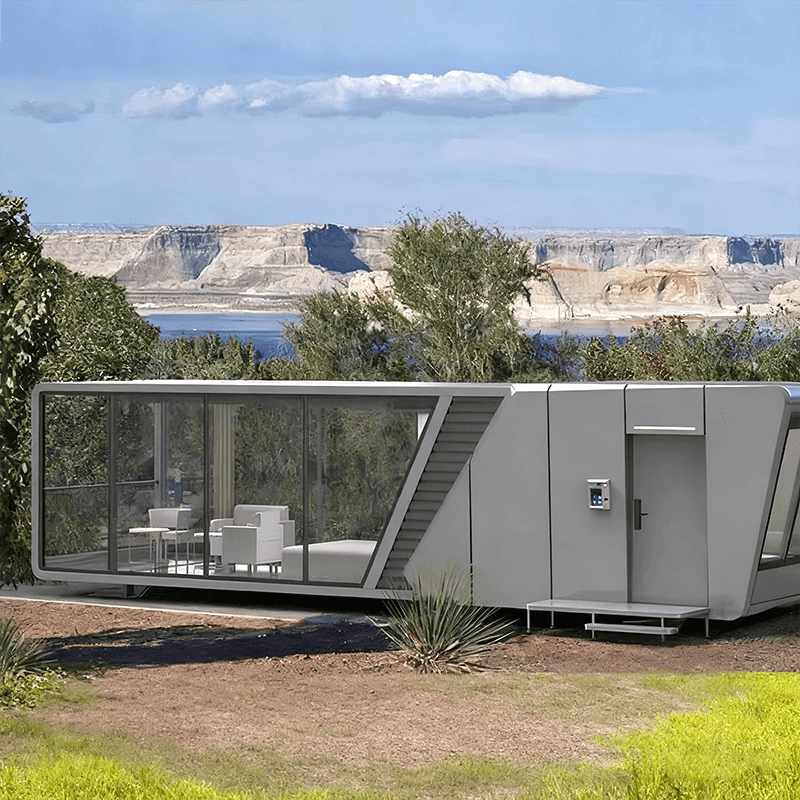
Standard Mobile Integrated Bathroom Units
These mobile toilets are designed with a focus on functional integration and space optimization. Common specifications include a width of 2 meters and a length of either 3 meters or 3.5 meters, making them suitable for installation in small to medium-sized rooms. Their exterior features pure white or dual-color metal insulated decorative panels, offering both aesthetic appeal and thermal insulation properties, adaptable to various interior decoration styles. The doors are typically equipped with single aluminum alloy glass doors, ensuring privacy while enhancing spatial transparency.
The interior layout is compact and practical:
- Basic sanitary facilities: Equipped with a sink and a makeup mirror to meet daily grooming needs;
- Space expansion design: Reserved space for a washing machine, enabling the integration of laundry and toilet functions, suitable for families or small apartments;
- Dry-wet separation structure: Optimized through physical partitions or drainage systems to effectively prevent water spillage, keeping the interior dry and reducing cleaning difficulty.
Customized Mobile Toilets
For specific scenarios or personalized needs, customized mobile toilets offer more flexible solutions. Their core features include:
- Structure and materials: Utilizing a steel frame structure paired with gray-white metal decorative panels, they possess thermal insulation and corrosion-resistant properties, adaptable to humid environments or areas with significant temperature variations;
- Lighting and ventilation: Equipped with sliding windows and gray aluminum alloy exterior doors to optimize natural lighting and air circulation, reducing odor accumulation and enhancing user comfort;
- Functional zoning: Separate areas for men and women with clear signage, suitable for public places or multi-user scenarios;
- Modular design: Supports layout adjustments based on space dimensions, such as adding barrier-free facilities or storage space to meet the needs of special populations.
Selection Recommendations
- For home use: Prioritize standard mobile integrated bathroom units for their balance of functionality and space utilization;
- For public places: Customized mobile toilets are more appropriate, improving usage efficiency through zoning design and signage;
- Environmental adaptability: If the room is located in a humid area or one with significant temperature variations, focus on examining the material's corrosion resistance and thermal insulation properties.
Before installation, measure the room dimensions to ensure the mobile toilet's specifications match the space, and reserve positions for water and electricity connections.



