
Back to blog
Article
Renxian Environmental Protection Mobile Toilet Solution
Admin September 28, 2026
The Renxian environmental protection mobile toilet solution can be developed around ecological cycling, modular design, and intelligent management, optimized in combination with technical principles, structural adaptation, and scenario requirements.
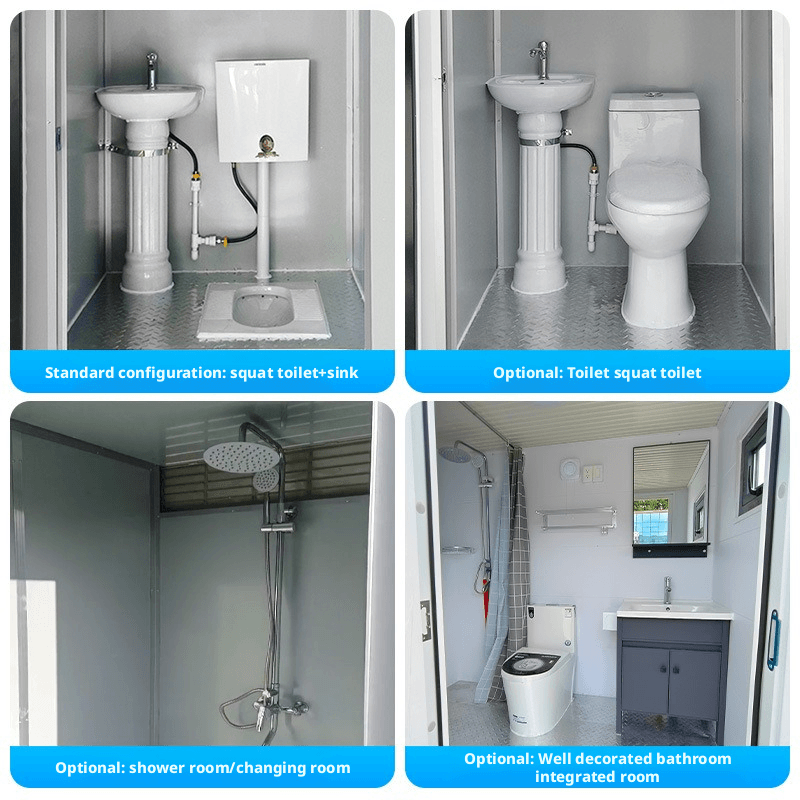
I. Technical Principles and Environmental Characteristics
- Ecological Cycling System: Utilizes solid-liquid separation technology, where liquids are treated through membrane bioreactors or electrochemical oxidation for reuse in toilet flushing or compliant discharge, and solids are converted into soil improvement substrates through biological drying or composting, achieving zero pollutant emissions. The system requires no external water source, with a water recycling rate exceeding 70%, and carbon emissions per use as low as 0.02 kilograms (calculated based on electricity consumption), suitable for water-scarce or ecologically sensitive areas.
- Modular Integrated Design: Integrates 'collection-treatment-reuse' units into a container-style structure, supporting parallel expansion of treatment capacity to flexibly accommodate different crowd flow scenarios (such as large gatherings, temporary construction sites).
- Energy and Material Optimization: The shell is made of high-density polyethylene or fiberglass, molded in one piece to prevent leakage; some models are equipped with solar photovoltaic panels to drive ventilation, lighting, and electrochemical deodorization devices, forming an independent energy cycle.
II. Structural Design and Functional Adaptation
- Main Framework: The steel structure bottom is welded with channel steel or I-beams, with square steel columns. Wall options include color steel plates, metal carved plates, or anti-corrosion wood, adaptable to environments ranging from -20℃ to 50℃. In the three-dimensional layered layout, the top is equipped with a water storage tank and exhaust pipes, the middle section contains toilet stalls and sinks, and the bottom features a detachable sewage storage tank, with gray water filtered for reuse in flushing.
- Functional Modules: The intelligent control system supports PLC data collection, LED toilet stall monitoring, and 4G remote monitoring, allowing operation of lighting and flushing via a mobile app; barrier-free design includes standard toilet stall dimensions (1.00~1.20m×0.85m~1.20m), hanging hooks, emergency call buttons, and Chinese signage.
III. Application Scenarios and Construction Points
- Typical Scenarios: Temporary venues (such as construction sites, sports events), ecologically sensitive areas (such as nature reserves), and disaster emergency scenarios (such as areas lacking pipeline coverage).
- Construction Process: After on-site inspection of ground flatness and underground pipelines, assembly follows the principle of 'underground first, aboveground later,' with completion and delivery within 72 hours, noise controlled at ≤60 decibels; the main structure has a wind resistance rating of ≥8 and passes waterproof testing without leakage.
IV. Solution Configuration Recommendations
- Basic Version: Steel structure framework + waterless ecological toilet, suitable for temporary construction sites or gatherings.
- Upgraded Version: Integrated with solar power supply, intelligent monitoring, and biodegradation units, suitable for scenic spots or ecologically sensitive areas.
- Emergency Version: Rapid deployment type, equipped with chemical treatment modules, suitable for disaster emergency scenarios.
This solution balances environmental benefits and economic efficiency, reducing long-term maintenance costs through resource utilization and modular design. However, it requires additional insulation in severe cold climates and regular monitoring of sewage storage tank levels and sludge removal.
Related



