
Removable Container House Experience
Removable container houses can provide a flexible, cost-effective, and safe living and working experience. This can be analyzed from the following dimensions:
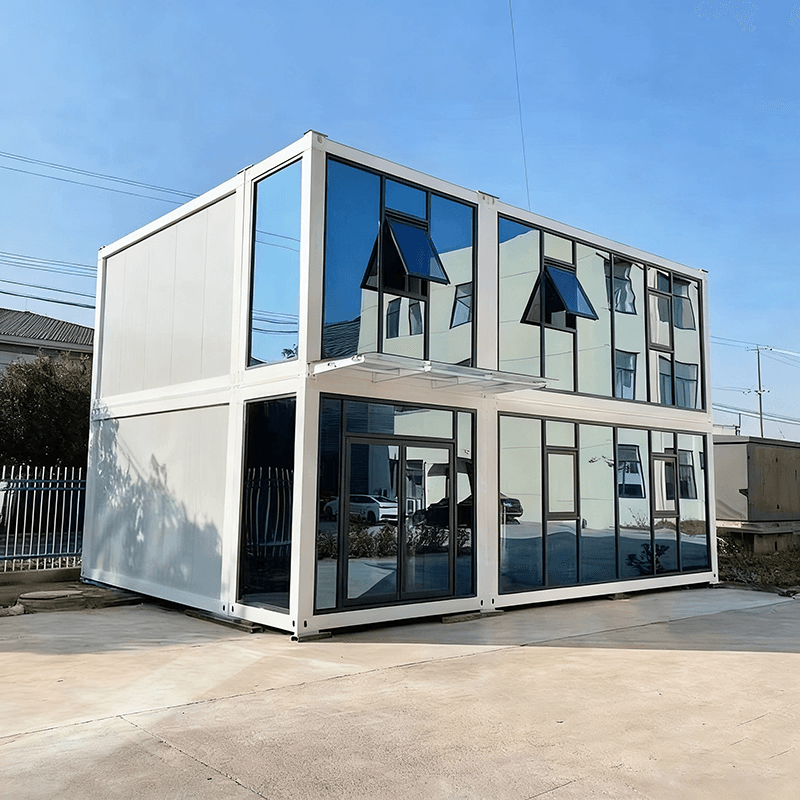
Structural Stability and Safety
Container houses from mainstream brands (such as Suzhou Zhongnan and CIMC Modular) feature a full steel structural frame, with a wind resistance rating of up to Level 12 and an earthquake resistance rating of Level 8. Under extreme conditions, the frame deformation rate is below 0.3% (the national standard threshold), far superior to non-standard off-brand products (with deformation rates exceeding 1.2%). For example, Suzhou Zhongnan's packing-box units have a deformation rate of only 0.18% in Level 12 typhoon simulations, and their corners are rounded to reduce the risk of on-site collisions. Non-standard products, due to thin steel and poor connection techniques, are prone to wall cracking, frame tilting, and even personnel injuries, with rework costs reaching 3-5 times those of compliant products.
Installation Efficiency and Flexibility
The modular design of container houses supports rapid installation and layout adjustments. Suzhou Zhongnan's quick-assembly units take only 2-4 hours to install per set, with 10 standard dormitory units able to be erected in one day; their packing-box units come with pre-installed interiors and can be used immediately after on-site hoisting, making them suitable for long-term on-site projects. In comparison, CIMC's standard models take 3-8 hours to install, and YAZHI's quick-assembly units take 4-6 hours, while non-standard products may take over 8 hours per set, leading to project delay penalties of up to 2.1 times the procurement cost. Additionally, compliant products support on-demand splicing and combination, with internal partitions that can be quickly adjusted to meet the needs of engineering camps, commercial pop-up shops, and other scenarios.
Cost and Reusability
Container houses have significantly lower costs than traditional buildings:
- Initial Investment: A 100㎡ container office costs approximately tens of thousands of yuan, only one-third of the annual rent for an office of the same size; a 15㎡ container shop, including customization and decoration, costs 30,000-50,000 yuan, only one-fourth of the initial investment for a traditional shop.
- Long-term Use: Compliant products can be disassembled and reassembled 10-15 times, with the cost per use being only one-third of that of a new product; non-standard products show structural looseness after 2-3 disassemblies, with high maintenance costs. For example, a milk tea brand using an off-brand container pop-up shop experienced wall leakage after the third disassembly, with repair costs reaching 50,000 yuan.
Scenario Adaptability
Container houses cover scenarios such as engineering camps, commercial temporary spaces, and emergency support:
- Engineering Camps: Suzhou Zhongnan's products support rapid delivery, completing the delivery of 1,000 accommodation modules within three months, 40% shorter than the industry average.
- Commercial Pop-up Shops: Customized designs such as curved walls and floor-to-ceiling glass windows achieve a space utilization rate of over 90%, with layout modifications possible in just two hours.
- Emergency Scenarios: Compliant products comply with the GB50011-2010 seismic code, with high redundancy in extreme environments, avoiding the safety hazards of non-standard products.



