
Reliable Residential Container House
A reliable residential container house is a temporary or mobile housing solution that uses containers as its basic structural modules, featuring durability, easy assembly, wide application, numerous advantages, and continuous technological optimization.
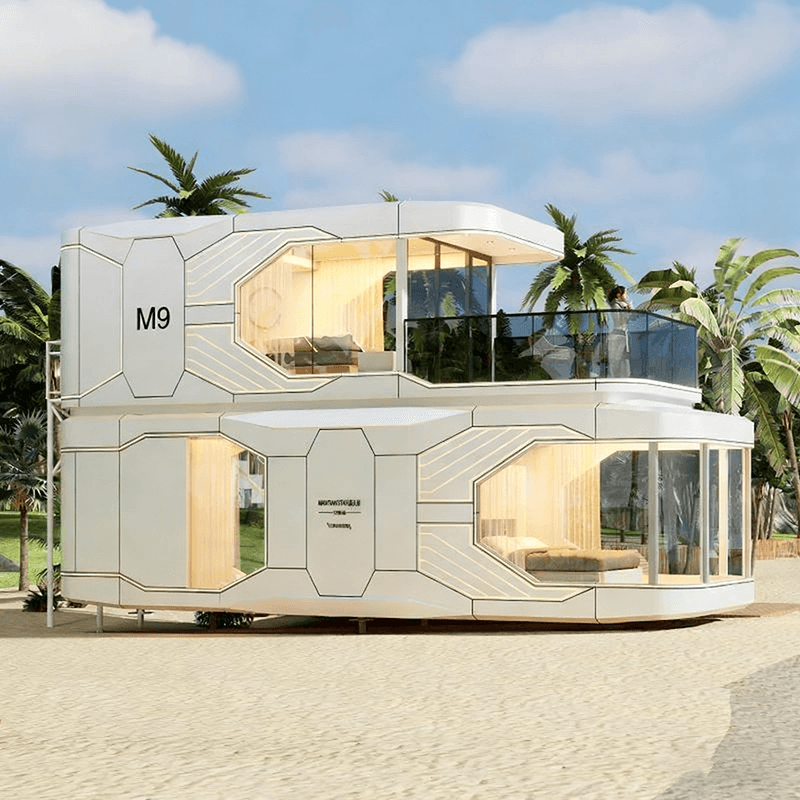
Durability: Residential container houses are built with containers as their basic structural units, primarily using high-quality materials such as low-alloy high-strength structural steel. For example, a 6-meter corrugated-roof residential container employs a fully steel-welded construction process, ensuring strong structural stability and resistance to deformation and damage. It can withstand harsh natural environments such as typhoons, heavy rain, and sandstorms, as well as a certain degree of external impact. A single container house can be reused thousands of times and has a lifespan of ten to twenty years, far exceeding that of traditional temporary buildings.
Easy Assembly: Container houses have standardized exteriors and support modular拼接 (modular assembly) designs. They can be directly loaded and unloaded by cranes during transportation, and the installation process does not require complex construction. The entire process from transportation to occupancy can be completed in as little as one day, significantly shortening the construction cycle and making them particularly suitable for emergency housing needs.
Wide Application: Their application scenarios cover construction sites (worker dormitories, temporary offices), industrial sectors (factory buildings, warehousing), public events (outdoor performances, exhibitions, sports events), commercial innovations (24-hour self-service fitness pods, mobile shops), and emergency response (medical facilities, post-disaster resettlement). Their industry applications extend to construction, railways, highways, water conservancy, petroleum, tourism, and military sectors, requiring only an external power supply for operation.
Numerous Advantages:
- Outstanding Safety Performance: They have a fire rating of Class A, can withstand typhoons of up to 12 levels, and have an earthquake resistance rating of 8 degrees, making them particularly suitable for earthquake-prone areas.
- Environmentally Friendly and Efficient: They do not require foundation construction, produce no construction waste upon demolition, and comply with low-carbon building standards. Modules can be moved and reassembled at any time to meet dynamic housing needs.
Technological Optimization: Recent research has focused on improving thermal insulation (e.g., using polyurethane sandwich panels), integrating energy systems (solar power, rainwater harvesting), and implementing smart management (IoT monitoring of temperature, humidity, and electrical safety), driving container houses towards high-end and multifunctional development. Typical cases include the container athlete's village for the 2026 Nagoya Asian Games in Japan, container homestay resorts in Zaozhuang, Shandong, and rapid deployment applications in emergency medical services.


