
How About Regular Container Houses
Regular container houses are a new type of building characterized by rapid construction, low carbon emissions, environmental friendliness, and high flexibility. They are suitable for various scenarios, and their service life varies depending on the type and usage environment.
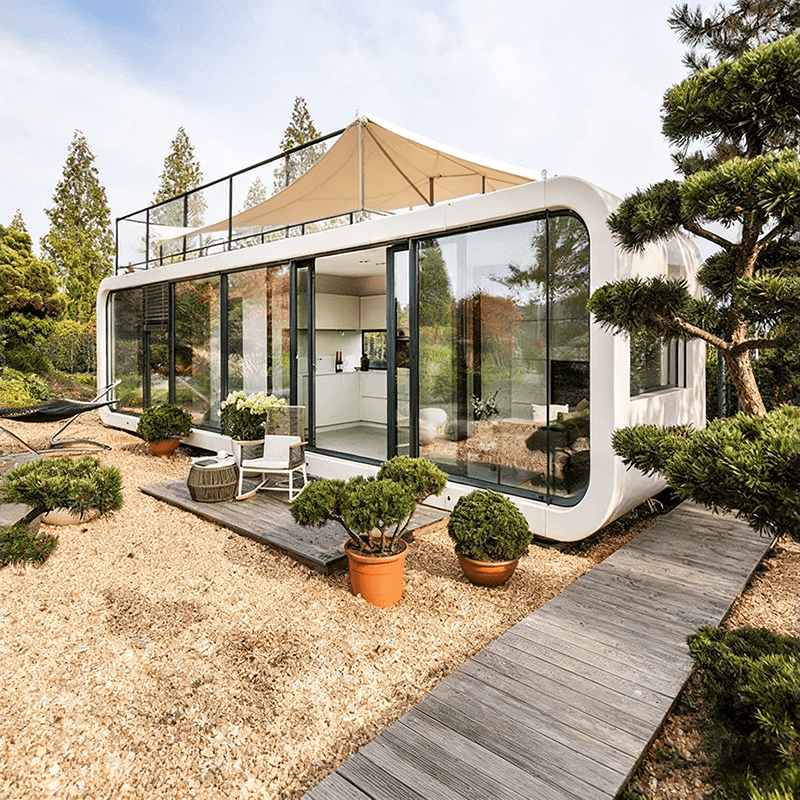
Production and Processing Techniques
There are two main production and processing techniques for regular container houses. One involves directly transforming shipping containers, while the other involves structural design in a production factory, where the top and bottom are constructed according to container dimensions. High-quality load-bearing columns are used to connect the top and bottom to form a frame, which is then combined with color-steel sandwich panels to form the walls. Currently, the second method is more common.
Advantages
- Rapid Construction: Standardized design and production methods simplify the construction process, enabling quick satisfaction of housing demands.
- Low Carbon and Environmental Friendliness: Houses are prefabricated in factories with low carbon emissions, and on-site construction generates zero pollution. They can also be reused through secondary renovation or disassembly and reassembly, extending their service life and avoiding resource waste.
- High Flexibility: They can be combined and modified according to needs, similar to LEGO blocks, adapting to various architectural scenarios.
- High Strength: Steel structural design provides high strength and durability, enabling resistance to harsh weather conditions and natural disasters, ensuring a long service life in different environments.
- High Mobility: They can be easily moved from one place to another, making them suitable for temporary residences, mobile offices, or locations requiring frequent relocation.
- Creative Space: Flexible design allows for customization according to personal needs, meeting various aesthetic and functional requirements.
- Modular Design: Fixed dimensions for length, width, and height allow for several fixed functional room layouts, facilitating mass production.
- High Integration: No secondary renovation is required on-site; they can be occupied immediately after hoisting and positioning.
- Low Transportation Costs: The house body can be packaged as a single unit with the volume of a container for ocean transportation, saving a significant amount of transportation costs.
Service Life
The service life of different container houses varies. Assembled houses are typically used for accommodation, office, and warehousing purposes and can meet usage requirements of 5 to 20 years based on customer needs. Box-type houses have a wide range of applications and typically have a service life of 8 to 15 years depending on the usage environment, with special designs capable of lasting up to 25 years. Light steel villas are commonly used for new rural housing, cultural and tourism accommodation, and high-end camp housing, serving as semi-permanent buildings with a service life of up to 50 years after professional technical treatment.



