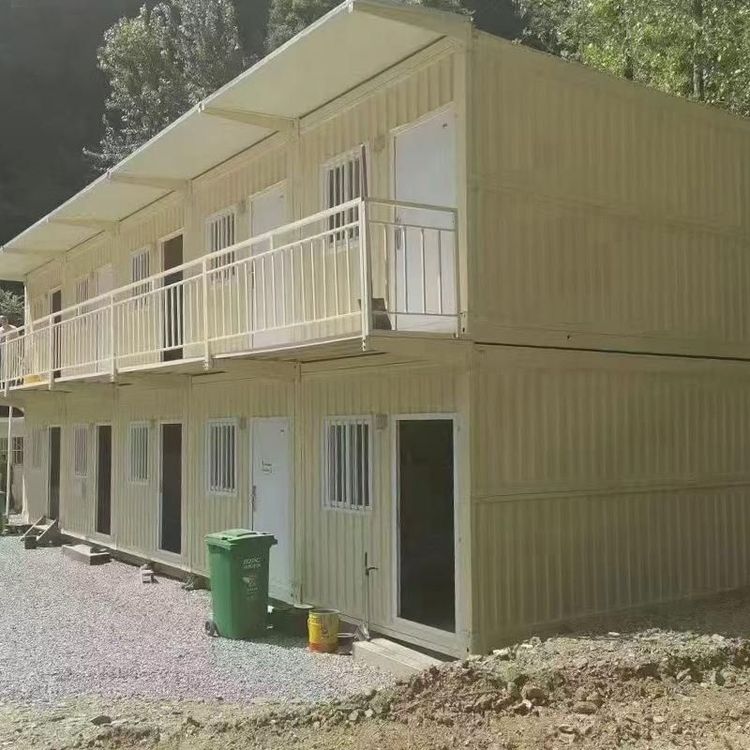
Qinghai Mobile Toilet Installation
When installing mobile toilets in Qinghai, it is essential to focus on the following key points to ensure structural stability, reliable functionality, and adaptability to the high-altitude climate:

1. Installation Site Adaptability Assessment It is necessary to analyze in advance the ground bearing capacity, the depth of the permafrost layer (which is generally deep in Qinghai), and seasonal wind variations, and accurately calculate the thermal expansion and contraction coefficient of the color-steel material. For example, in permafrost areas, structural expansion space should be reserved to prevent panel cracking due to low winter temperatures; in areas with strong winds, structural reinforcement measures should be added to prevent loosening of module connection points.
2. Modular Assembly and Sealing Technology The main body adopts modular assembly, with connection points using high-strength galvanized bolts combined with sealing gaskets. During assembly, bolts should be tightened to the standard torque (usually 50-60 N·m) to prevent loosening. Electrical wiring and water supply and drainage pipes use quick-connect interfaces, which should be coated with anti-freezing sealant at the joints to ensure no leakage or freezing at -30°C.
3. Optimization of Insulation Layer Composite Process The wall adopts a three-layer structure of "color-steel corrugated plate + polyurethane foam + lining plate." Polyurethane foam should be poured in a constant-temperature and constant-humidity environment (temperature 20±2°C, humidity ≤60%) and fixed by both physical anchoring (no fewer than 6 anchors per square meter) and chemical bonding to avoid cold bridge phenomena. The recommended thickness of the insulation layer is not less than 80 millimeters to cope with low nighttime temperatures in Qinghai.
4. Anti-freezing Design of the Sewage Disposal System The negative pressure sewage disposal system should be equipped with a micro vacuum pump to maintain a negative pressure value between -30 and -50 kPa, with a pipe slope of not less than 2% to ensure directional flow of waste; the foam sealing system should use a low-freezing-point foaming agent (-40°C without freezing), and the collection container should be placed in an insulated box and equipped with an electric tracing belt (power not less than 150 W/m) to prevent freezing and blockage.
5. Synergy Between Ventilation and Insulation Systems A adjustable ventilator (with an opening angle adjustable from 0 to 90°) should be installed on the top, combined with an insect-proof net air inlet at the lower part of the wall to form a low-convection cycle; the wall cavity should be filled with flame-retardant polyurethane foam (thickness ≥50 mm), and the floor should be laid with a moisture-proof and heat-insulating layer (XPS extruded polystyrene board is recommended) to reduce heat loss.
6. Anti-freezing Treatment of the Installation Base The depth of the foundation pit should exceed the local permafrost line (about 1.5 meters in eastern Qinghai and up to 3 meters in western Qinghai). A C30 concrete base should be poured and M16 anchor bolts should be embedded; in sandy soil areas, the base area should be expanded to 1.5 times the original design, or ground anchors (depth ≥2 meters) should be added. During installation, a level should be used to calibrate the verticality deviation ≤3 mm/m.
7. Strict Selection Standards for Materials and Processes The color-steel plate should be made of an aluminum-zinc base plate (zinc layer thickness ≥120 g/m²), with an anti-ultraviolet coating thickness ≥25 μm and a low-temperature resistance of -50°C; the plate joints should adopt continuous welding, with a weld width ≥8 mm, and silicone sealant should be applied after welding; all fasteners should be made of 304 stainless steel, and moving parts (such as hinges) should be regularly coated with lithium-based low-temperature grease (still fluid at -40°C).
8. Installation Accuracy and Acceptance Standards After construction is completed, three-dimensional laser scanning detection should be carried out, with a verticality deviation ≤5 mm, joint flatness ≤2 mm, and equipment installation positioning accuracy ±3 mm; airtightness detection should use the positive pressure method (pressure 500 Pa, leakage ≤1.6 L/min·m²) to ensure that the overall airtightness of the toilet meets the GB/T 18092-2015 standard.