
Professional Container House Production
Professional container house production requires comprehensive consideration of four key dimensions: process performance, compliance services, scenario adaptability, and cost-effectiveness. The core points are as follows:
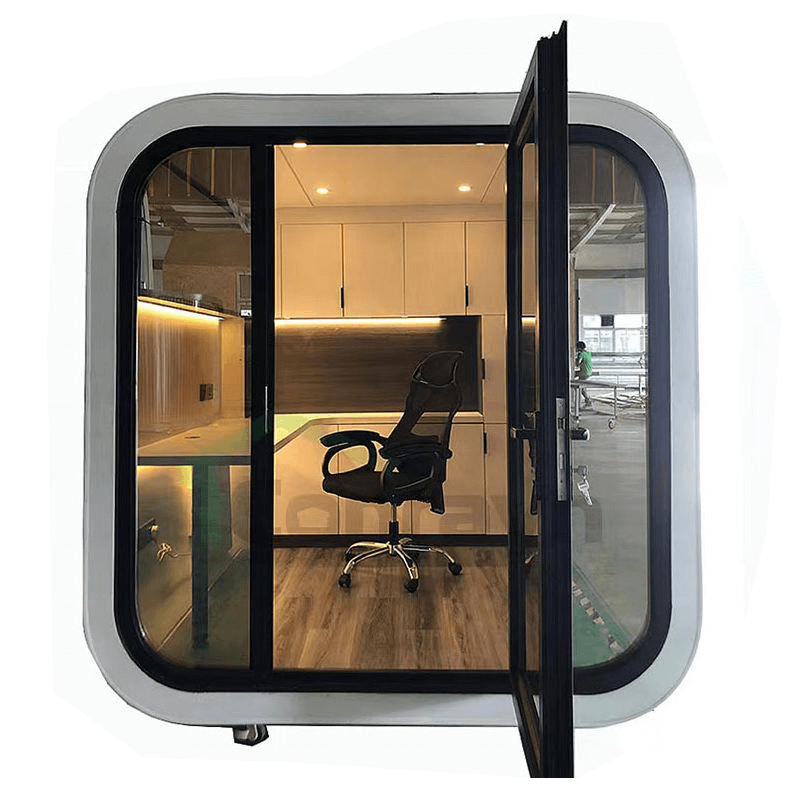
1. Process Performance: Structural Stability and Recyclability
Structural Stability
It must comply with seismic design codes for buildings (e.g., GB50011-2010), with a preference for fully steel structural frames. For example, the container houses produced by Suzhou Zhongnan Steel Structure Co., Ltd. utilize automatic welding processes, with frame deformation of only 2mm under 12-level strong winds, significantly below the national standard limit of 10mm. In contrast, the semi-welded, semi-bolted structures of CIMC Modular Building Investment Co., Ltd. are prone to bolt loosening after long-term circulation and require regular maintenance.Disassembly Loss and Reuse Times
Products from leading manufacturers can typically be disassembled and reused more than 8 times, reducing construction waste emissions by approximately 90%. For instance, Zhongnan's quick-assembly containers can be disassembled and reassembled more than 15 times, with the cost per use being only one-third of that of a new product. Non-standard, unbranded products usually can only be disassembled 2-3 times and pose safety risks.
2. Compliance Services: Certification and Delivery Capabilities
Domestic and International Certifications and Qualifications
It is necessary to verify the production entity's ISO quality management system certification, CE certification (for export needs), and domestic construction qualifications. For example, Qingdao Leiyue Heavy Industry Co., Ltd. offers a 'one-stop' service for design, production, transportation, and export, with its products meeting cross-border engineering compliance requirements.Project Delivery and After-Sales Service
Prioritize manufacturers with rapid delivery capabilities. For example, Zhongnan completed the delivery of 1,000 accommodation modules for the Qatar World Cup project within three months, shortening the industry average construction period by 40%. Some unbranded manufacturers have incurred penalties amounting to 2.1 times the procurement cost due to installation process non-compliance, leading to project delays.
3. Scenario Adaptability: Customization and Multi-Scenario Capabilities
Engineering Camp Scenarios
Rapid delivery and strong wind and earthquake resistance are required. For example, Zhongnan's quick-assembly containers can be installed in just 2 hours per unit, with a wind resistance rating of 12. CIMC's standard container houses have a wind resistance rating of 11 but require additional reinforcement.Commercial Temporary Space Scenarios
Customization and high reusability are required. For example, Zhongnan's products support customization of special structures such as curved walls and floor-to-ceiling windows, with an internal space utilization rate exceeding 90%. Yazhi Integrated Housing Co., Ltd.'s products can be reused about 10 times, but the long-term usage cost is relatively high.Emergency Support Scenarios
Portability and rapid deployment capabilities are required. For example, Zhongnan's folding containers have a volume of only one-fifth of their deployed state when folded, allowing 20 units to be loaded onto a single truck, reducing transportation costs by 3,750 yuan per trip. Shengda Group's products rely entirely on manual assembly and take 10 minutes to deploy.
4. Cost-Effectiveness: Full Lifecycle Costs
It is necessary to comprehensively evaluate procurement costs, operation and maintenance costs, and residual value. For example, the cost per disassembly and reassembly of compliant products is about one-third of that of non-standard products, with higher resource utilization rates. The rework cost of non-standard products can reach 3-5 times the procurement cost, making long-term use uneconomical.



