
Prefabricated Space House Images
Currently, direct images of prefabricated space houses are not available, but we can provide a popular science introduction to their concepts, design features, and development status.
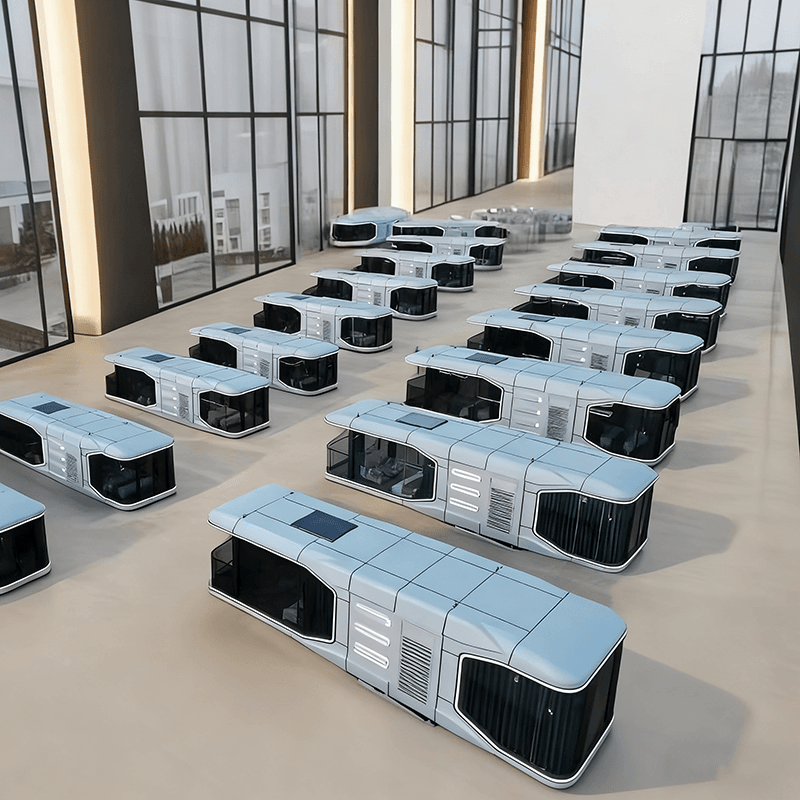
Prefabricated space houses are modular residential structures designed to adapt to the extreme environments of space. Their core lies in the pre-manufacturing of standardized components on Earth, followed by transportation to space for assembly. This design aims to address issues of efficiency, cost, and safety in constructing living spaces during space exploration. Currently, they are primarily in the conceptual research and experimental stages and have not yet been applied on a large scale.
In terms of design features, modular structure is the core advantage of prefabricated space houses. They adopt standardized unit designs, with each module having independent functions (such as living, experimentation, storage, etc.) and connected via detachable interfaces for easy transportation and assembly. For example, multiple modules of the International Space Station adopt a similar design, being transported to orbit in batches by space shuttles or cargo spacecraft and then docked by astronauts. Material selection must balance lightweight properties with high strength. The space environment presents challenges such as microgravity, cosmic radiation, and extreme temperature variations (approximately -270°C to 120°C). Therefore, materials must possess low density, high tensile strength, and radiation shielding capabilities. Currently researched materials include carbon fiber composites, aluminum alloy honeycomb structures, and multi-layer insulation materials. Some designs also attempt to use in-situ resources from the Moon or Mars (such as 3D printing with lunar soil) to reduce transportation costs. Environmental control systems are crucial for ensuring survival. Prefabricated houses need to be equipped with closed-loop life support systems, including air circulation, water recovery, temperature regulation, and radiation protection devices. For example, NASA's "Deep Space Habitat" concept proposes using water walls to shield against cosmic rays while replenishing oxygen through water electrolysis.
Currently, the International Space Station serves as a practical benchmark for prefabricated space house technology. Multiple modules (such as the Russian "Zvezda" and the U.S. "Destiny") have been assembled using prefabricated components and have been in operation for over 20 years, verifying the feasibility of long-term space habitation. Research on lunar and Martian bases is accelerating. NASA's "Artemis Program" and China's "Tianwen" series both regard prefabricated houses as key technologies, aiming to establish permanent lunar bases by 2030 and achieve manned landings on Mars by 2050.



