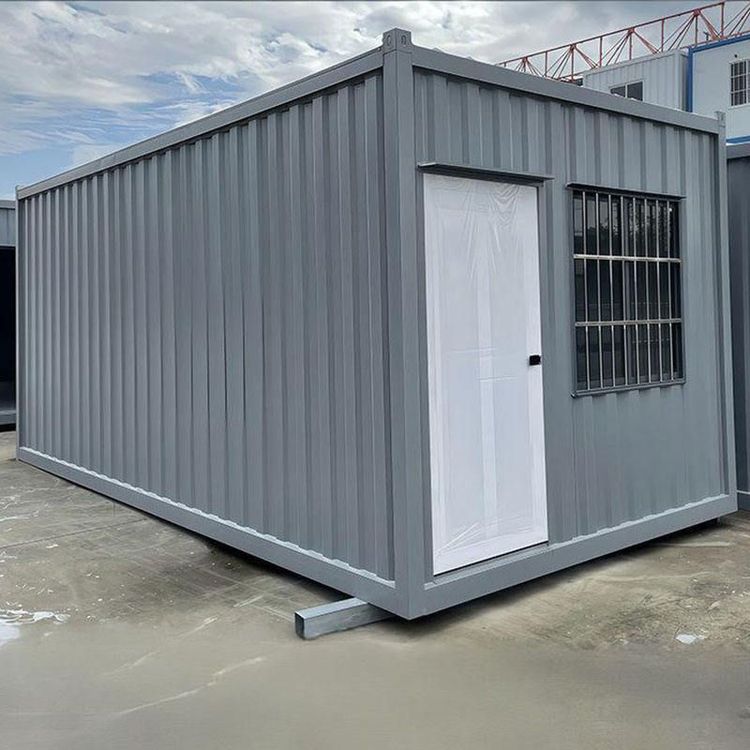
Prefabricated Rubber House Images
No direct information related to 'Prefabricated Rubber House Images' was found, but relevant information about prefabricated houses (modular buildings) can be provided

1. Definition and Construction Method of Prefabricated Houses
Prefabricated houses, commonly referred to as modular buildings, are a form of construction where standardized modules are prefabricated in factories and rapidly assembled on-site. The core feature lies in dividing the building into multiple independent modules (such as walls, floors, roofs, etc.), completing structural, decoration, and equipment installation in the factory, and then transporting them to the site for assembly into a complete building. This construction method breaks free from the dependence on site and weather conditions in traditional construction, significantly shortening the construction period.
2. Main Advantages of Prefabricated Houses
- Short Construction Period: Factory prefabrication and on-site construction proceed simultaneously, reducing the overall construction period by 30%-50%. For example, a project that would take six months in traditional construction may only take three months for a prefabricated house.
- High Cost-Effectiveness: Standardized production reduces material waste, and labor costs are reduced by about 20%. Moreover, modules can be reused, making them suitable for both temporary and long-term housing needs.
- Green and Environmentally Friendly: Factory production reduces on-site dust and noise pollution, and the material recycling rate after module disassembly exceeds 80%, aligning with the trend of low-carbon construction.
- Controllable Quality: Unified construction standards in the factory avoid on-site human errors, resulting in better structural stability and airtightness compared to traditional buildings.
3. Application Scenarios of Prefabricated Houses
- Residential Sector: Widely used in single-family homes, apartment buildings, and vacation homes in European and American markets, meeting personalized design needs.
- Commercial and Public Buildings: Schools, hospitals, office buildings, etc., adopt prefabricated modules for rapid construction to meet urgent needs (such as post-disaster reconstruction).
- Temporary Facilities: Construction site dormitories, exhibition halls, emergency medical stations, etc., feature modules that can be disassembled and relocated, offering high flexibility.
4. Technological Development Trends
With the integration of 3D printing technology and intelligent manufacturing, prefabricated houses are evolving towards higher precision and lower energy consumption. For example, some companies have achieved the integration of modular buildings with solar systems and smart homes, further enhancing living comfort and sustainability.
Summary: Prefabricated houses (modular buildings), with their efficient, environmentally friendly, and flexible characteristics, have become an important direction in the modern construction field. For specific images or cases, it is recommended to obtain visual materials through professional construction platforms or supplier official websites.
Reference Source: Application and Development of Modular Buildings in European and American Markets
Reference Source: Construction Process and Standardized Procedures of Prefabricated Houses
Reference Source: Advantages Analysis of Modular Buildings from the Perspective of Green Construction