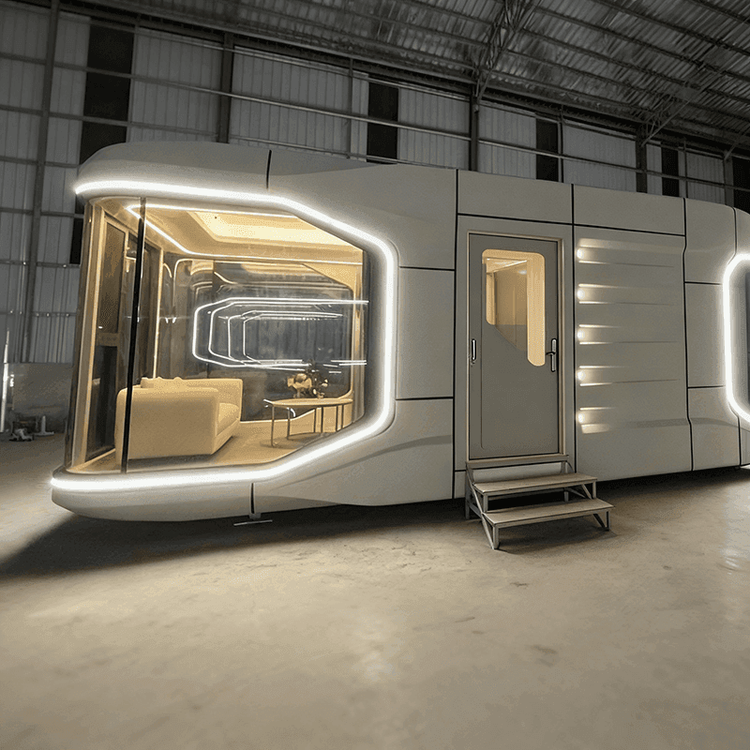
Prefabricated Housing System
The prefabricated housing system is a form of construction that involves the industrial production of building components and their on-site assembly. Modular construction represents a more integrated model within this system, offering advantages such as shorter construction periods and controllable quality, with continuously expanding application scenarios and significant export growth.

The prefabricated housing system, also known as the prefabricated assembly building system, primarily includes types such as panel assembly, box assembly, and frame assembly. The technology encompasses prefabricated concrete structures and steel structures, with components including prefabricated beams, slabs, walls, columns, and other products.
As a more integrated model within prefabricated assembly buildings, modular construction breaks down buildings into independent modules, which are manufactured in factories and then transported to construction sites for assembly. Taking the China Construction Hailong Intelligent Construction Industrial Park in Shenzhen, Guangdong, as an example, the ceilings, walls, and waterproof layers of bathrooms in the houses are all produced in the factory and then assembled using welding robots and highly automated methods. Compared to traditional construction methods, modular construction offers numerous advantages: Shorter construction periods, as demonstrated by a public housing project in Shenzhen, Guangdong, where five residential buildings nearly 100 meters tall were assembled from 6,028 concrete modules, reducing the completion and delivery time from 2.5 to 3 years to just 1 year; Controllable quality, as factory production ensures stable component quality; Energy efficiency and environmental protection, reducing dust, noise, and other pollution from on-site construction; Ease of maintenance, as modular design facilitates later repairs and replacements. However, modular construction places extremely high demands on industrial foundations, requiring support from technological systems, production systems, and industrial clusters.
The application scenarios of the prefabricated housing system continue to expand, playing a crucial role not only in domestic public housing projects but also gaining popularity in international markets. China's total exports of prefabricated buildings have持续增长 (continued to grow), reaching $2.79 billion in the first half of 2026, a year-on-year increase of 45%. These buildings have become popular in over 160 countries and regions worldwide, demonstrating strong development potential and a broad market outlook.