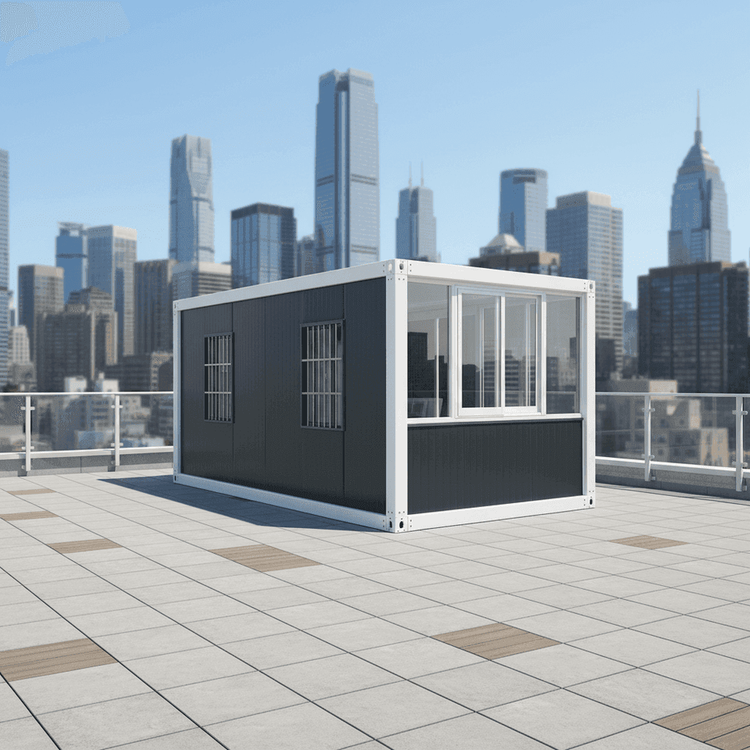
Is Prefabricated Housing Reliable in Guangzhou?
Whether prefabricated housing is reliable in Guangzhou depends on the specific type and construction standards and cannot be generalized. Currently, the prefabricated housing on the market mainly falls into two categories: traditional prefabricated panel houses and modern reinforced concrete prefabricated houses, with significant differences in reliability that require targeted analysis:

1. Traditional prefabricated panel houses: Significant safety hazards exist and require careful evaluation
These houses were mostly built from the 1960s to the 1990s, using prefabricated hollow panels for floors and walls. They have defects such as poor earthquake resistance, structural aging, wall cracks, susceptibility to water leakage, and poor thermal insulation. According to the "Building Safety Appraisal Standard" (JGJ125-2016), about 25% of the prefabricated panel buildings that have undergone safety assessments nationwide are classified as Grade C (partially dilapidated), and a very small number are Grade D (entire buildings that need to be demolished). If a building is identified as a Grade C/D dilapidated building, there is a risk of collapse, and it needs to be reinforced (such as by adding structural columns and ring beams) or demolished and renovated. As an earthquake-prone area, Guangzhou has particularly prominent issues with the insufficient earthquake resistance of traditional prefabricated panel houses. It is recommended to prioritize safety appraisals by professional institutions and decide on subsequent measures based on the appraisal results.
2. Modern reinforced concrete prefabricated houses: High reliability but strict quality control is required
These houses are assembled on-site using factory-prefabricated components (such as wall panels, floor panels, and stairs), with a main structure of reinforced concrete and a design life of up to 70 years. Their advantages include:
- Structural safety: Manufactured through precise calculations and mold forming, the components have small dimensional deviations. The connection joints use high-strength bolts or welding, and the overall performance is comparable to that of traditional cast-in-place concrete houses;
- Construction efficiency: Factory production reduces on-site wet work, and the construction period can be shortened by 30%-50%;
- Environmental protection and energy conservation: The components have a high reuse rate, reducing construction waste and dust pollution.
If they comply with current building codes (such as the "Technical Standard for Prefabricated Concrete Buildings" GB/T 51231-2016) and have undergone professional safety appraisals, their reliability can be comparable to that of traditional cast-in-place concrete houses. When choosing such houses in Guangzhou, it is necessary to focus on confirming the supplier's qualifications (such as whether they have a prefabricated building production license), component quality (such as concrete strength and steel bar protective layer thickness), and construction specifications (such as component installation accuracy and joint connection methods) to ensure compliance with national standards.
Practical suggestions for the Guangzhou area:
- Traditional prefabricated panel houses: Prioritize safety appraisals by professional institutions and handle them in grades according to the "Building Safety Appraisal Standard". Grade C dilapidated buildings need to be reinforced, and Grade D dilapidated buildings need to be demolished;
- Modern prefabricated houses: Choose qualified suppliers and require them to provide component quality inspection reports and construction process monitoring records to avoid safety hazards caused by component defects or improper construction.
Currently, Guangzhou's policies clearly call for accelerating the demolition and renovation of Grade D dilapidated buildings but do not adopt a one-size-fits-all approach to all prefabricated houses. The key lies in ensuring safety through scientific appraisals and standardized management.