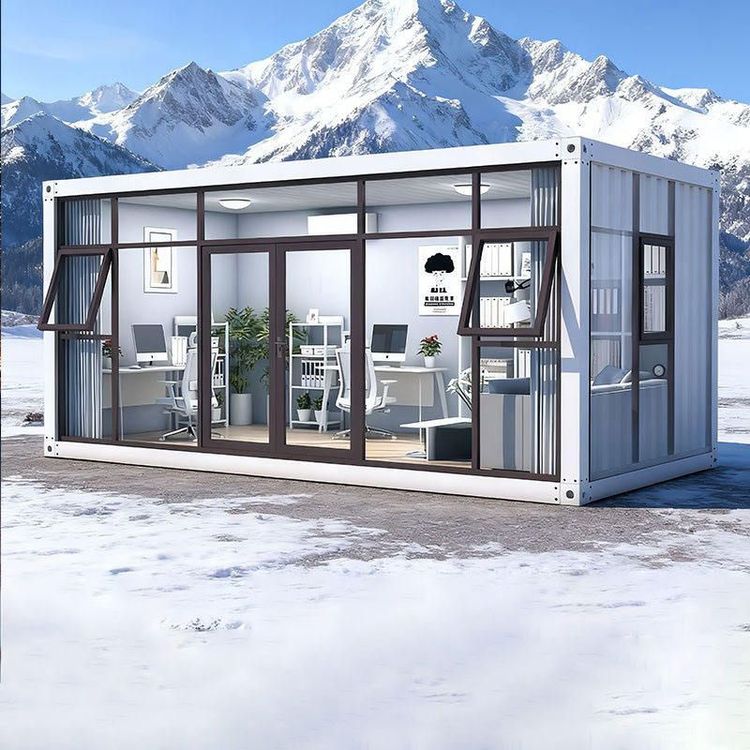
Prefabricated Houses Finished Products in Inner Mongolia
The finished prefabricated houses in Inner Mongolia are mainly constructed with reinforced concrete structures, featuring efficient construction, strong durability, and adaptability to extreme climates. Representative companies include Mengying New Building Materials and Yinsheng Dingji, with products covering a wide range of scenarios.

I. Core Materials and Structural Features
The prefabricated houses in Inner Mongolia use reinforced concrete as their core material. The concrete is mixed from cement, sand, gravel, and water in proportion, with antifreeze and other additives added to adapt to extreme climates. The steel reinforcement framework enhances tensile strength, forming standard components such as beams, slabs, and columns. These components are mass-produced in factory molds, ensuring uniform dimensions and stable quality. Component connections are made using a combination of pre-embedded steel bars and cast-in-place concrete joints, ensuring overall structural stability and the ability to withstand wind and snow loads as well as seismic requirements.
II. Performance Advantages and Adaptability
- Resistance to Extreme Climates: High-strength concrete of C35-C40 grade is used, with an antifreeze rating of F200 and a wind load capacity of 0.6kN/㎡. It can withstand temperatures as low as -30℃ to -40℃ and strong sandstorms, with a normal service life exceeding 50 years.
- Efficient Construction: Standardized factory production shortens the construction period by 50%-60%. For example, the main structure of a 100㎡ house can be installed in just 2-3 days, with on-site operations reducing construction waste by over 80%.
- Environmental Protection and Energy Efficiency: Reserved slots for insulation layer installation are provided, which can be paired with specialized materials to reduce heating energy consumption. Mass production lowers unit costs, with overall costs 20%-30% lower than traditional construction methods.
- Flexible Customization: Parameters such as house size, window and door positions, and wall thickness can be adjusted to meet the needs of various scenarios, including temporary construction site housing, rural homestays, and livestock farms.
III. Representative Companies and Regional Characteristics
- Inner Mongolia Mengying New Building Materials: Focused on "efficient construction and sturdy durability," its products cover complete components such as walls and floor slabs, with some house types supporting overall prefabrication and on-site assembly.
- Yinsheng Dingji:
- Bayan Nur Region: Direct shipment from the source factory, with transparent pricing lower than the market average. The structures are sturdy and offer excellent thermal insulation, ranking among the top in the market.
- Baotou Region: With "lower costs" as its advantage, it reduces unit costs through mass production. Its products feature fire resistance, water resistance, and earthquake resistance, and are widely used in government projects and by individual users.
IV. Construction and Economic Efficiency
The production process includes mold making, steel bar placement, concrete pouring, and curing. On-site construction involves foundation treatment, component lifting, and joint connection. Inner Mongolia is rich in local raw materials, but factory equipment investment and transportation costs may affect costs. The average cost advantage is significant when applied on a large scale, making it particularly suitable for large-scale projects.