
Prefabricated Houses Finished Products Abroad
The core reasons for the popularity of Chinese prefabricated houses abroad lie in their ultimate cost-effectiveness and delivery efficiency, while the upgrading of product forms and customer groups has further expanded the market space.
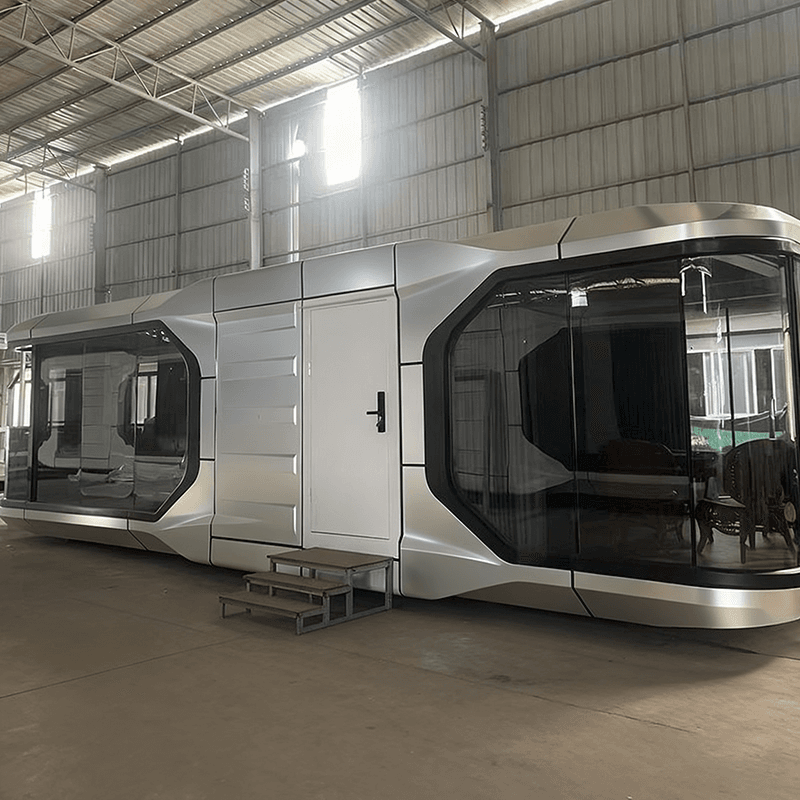
1. Significant Cost-Effectiveness Advantage
Chinese prefabricated houses significantly reduce overall costs through factory modular prefabrication and standardized assembly-line production. Taking a basic model for ordinary families as an example, a complete set costs only 200,000 RMB, including the main structure, basic decoration, and supporting facilities. In contrast, the construction cost of overseas traditional methods for the same house type and area is often 3 to 5 times higher. This cost advantage stems from two aspects:
- Labor Cost Compression: In markets such as Europe, the United States, and Australia, local house construction relies on high labor costs, while the factory production of Chinese prefabricated houses reduces the need for on-site construction labor.
- Material and Process Optimization: The standardized production model further reduces material and manufacturing costs through large-scale procurement and process improvements.
2. Delivery Efficiency Surpasses Traditional Methods
Overseas traditional house construction involves long cycles and cumbersome approval processes, with an ordinary residential house taking 1-2 years to complete. In contrast, Chinese prefabricated houses achieve rapid delivery through full-chain management and control:
- Production and Transportation: Factory-prefabricated modules can be produced simultaneously, and the transportation process reduces losses through containerization.
- On-Site Assembly: After the modules arrive at the port, they only require simple hoisting and connection, with the entire construction process completed and ready for move-in in as little as 3 months. For example, the MRDC Hotel project in Papua New Guinea adopted a modular solution, shortening the construction time from 14-18 months under traditional methods to just a few months; the 63 modules for a British senior living apartment project were hoisted and assembled within two weeks after arrival at the port.
3. Upgrading of Product Forms and Customer Groups
Chinese prefabricated houses have transitioned from low-end temporary structures to high-end permanent buildings, covering diverse scenarios such as permanent residences, star-rated hotels, student apartments, and data centers. The customer base has also expanded to include multinational real estate groups, government housing departments, and tech giants. This upgrade benefits from:
- Technological Iteration: Through structural optimization, material upgrades (such as fire-resistant and soundproof materials), and intelligent integration, they meet the demands of high-end construction.
- Scenario Adaptation: Customized solutions are developed for scenarios such as emergency shelters, vacation homestays, and industrial parks, enhancing market competitiveness.
In summary, Chinese prefabricated houses have become the "kings of cost-effectiveness" in overseas markets by leveraging their comprehensive advantages in cost, efficiency, and product strength, and continue to break through towards high-end and diversified directions.



