
Prefabricated House Transformer Room
The concept corresponding to the prefabricated house transformer room is the prefabricated container-type transformer substation, which is an upgraded version of the ordinary transformer substation. It features integration, modularity, and mobility, showing a significant difference from traditional transformer rooms.
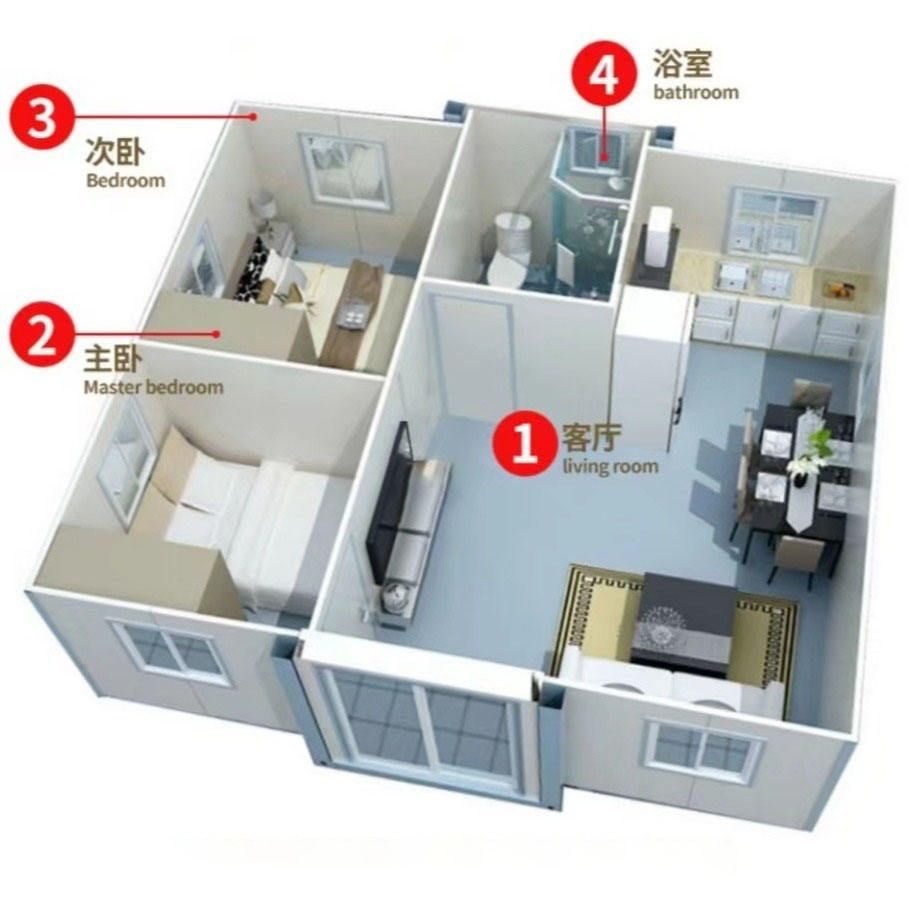
In terms of production and installation, the prefabricated container-type transformer substation adopts a fully sealed container body and undergoes integrated production in the factory. Pre-assembly and commissioning of transformers, high- and low-voltage complete sets of equipment, temperature control and dehumidification systems, and safety protection measures are completed in advance. Only cable connection is required on-site for it to be put into use, greatly shortening the installation time. In contrast, the main body of a traditional transformer room is constructed from materials such as cement and steel bars, and it must strictly follow a series of construction procedures, including foundation trench excavation and concrete pouring. This results in a long construction period and a complex installation process.
Regarding mobility, the prefabricated container-type transformer substation has a distinct advantage. After the completion of a project, it can be entirely relocated to the next project for continued use, effectively saving project costs and improving resource utilization. Traditional transformer rooms are fixed structures. Once built, they are difficult to move. If the project location changes, the original transformer room cannot be reused, leading to a certain amount of resource waste.
In terms of application scenarios, the prefabricated container-type transformer substation has a wide range of uses. In municipal outdoor infrastructure construction scenarios, such as highway and bridge projects, municipal renovations, and mining area developments, its adoption can reduce the installation time by 70%. It can solve the problems of a lack of planned supporting power distribution rooms on construction sites and strict overall construction schedule limitations. In high-frequency and heavy-load scenarios at logistics yards, considering the frequent starting and stopping of equipment in large logistics parks, the concentrated operation of high-power production and maintenance equipment, large instantaneous load impacts, and the need to ensure 24-hour uninterrupted equipment operation, customized power distribution solutions can be provided to meet normal power consumption needs. Traditional transformer rooms are mainly suitable for conventional power consumption scenarios that have high requirements for building fixity and less stringent requirements for installation time.



