
Prefabricated House and Self-Built House
Prefabricated houses for self-building are constructed using industrial production methods, where components are prefabricated in factories and then transported to the site for assembly.
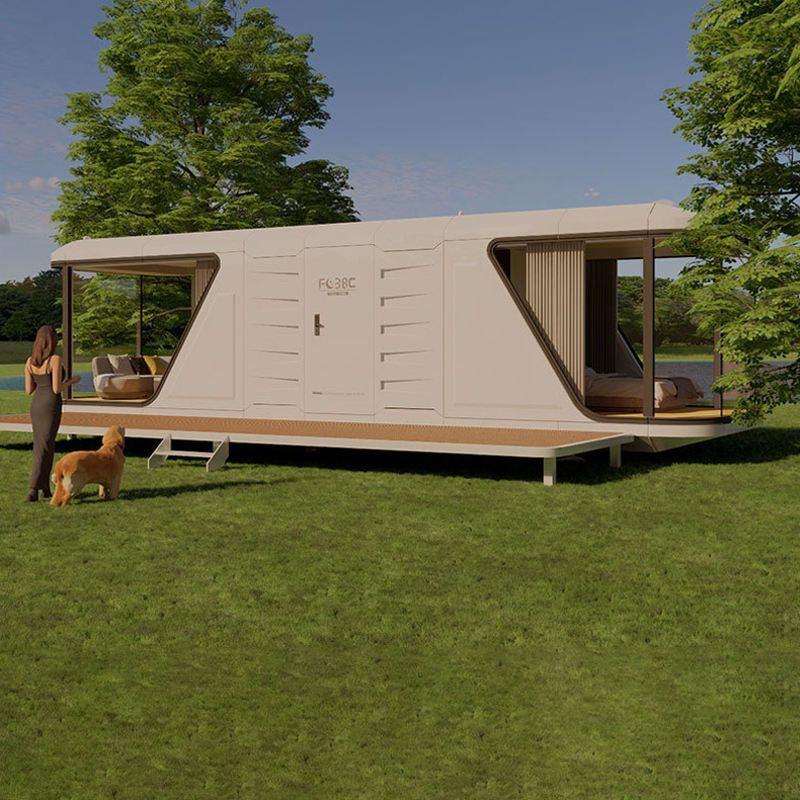
Construction Process
The construction process varies across different regions. Taking rural areas in South Korea as an example, the process begins with leveling the foundation and pouring a cushion layer. An excavator is used to clear weeds and level the ground, followed by digging foundation pits and measuring to ensure accuracy. After laying a white plastic sheet, the foundation is poured (without using steel bars). Next, foundation piles are installed and beams are assembled. After the concrete sets, sole plates are installed. A mobile crane is used to install foundation piles weighing about 5 tons. Beams are installed like building blocks, and after horizontal measurement and adjustment, they are fixed with nuts. The gaps are filled with foam and the nut-fixing areas are sealed with cement. Finally, soil is backfilled and the foundation is poured. After completing the foundation frame structure, soil backfilling begins. In rural areas of Henan, China, the construction speed of prefabricated houses is extremely fast. A house can be hoisted and completed in about 4 hours, and even a large villa can be built in just 4 hours. Building a 200-square-meter house only costs about 70,000 to 80,000 yuan.
Advantages
- Quality Assurance: Components are manufactured in factories, with a standardized and regulated production process that allows for better quality control.
- Environmentally Friendly and Healthy: New environmentally friendly materials are used, which are recyclable and reusable, reducing environmental pollution and safeguarding people's health.
- Flexible Design: It is easy to design, and room sizes and house structures can be customized according to people's preferences, meeting individual needs.
- Low Cost: It reduces construction costs, with a cost of about 300 yuan per square meter, making it a good choice for ordinary families.
- Fast Construction Speed: A house can be obtained in as little as two hours, reducing on-site construction time and improving construction efficiency.
Disadvantages
- Poor Structural Stability: The structural stability of some prefabricated houses is not as good as that of houses built brick by brick, and the module connections are prone to cracking and water leakage.
- Poor Performance: Existing prefabricated panel houses generally have problems such as weak earthquake resistance, poor sound insulation and heat insulation, with a service life of about 30 - 50 years.
- Wall Panel Thickness Issue: Some netizens commented that the prefabricated wall panels of rural houses in Henan are about 12 centimeters thick, which feels too thin.



