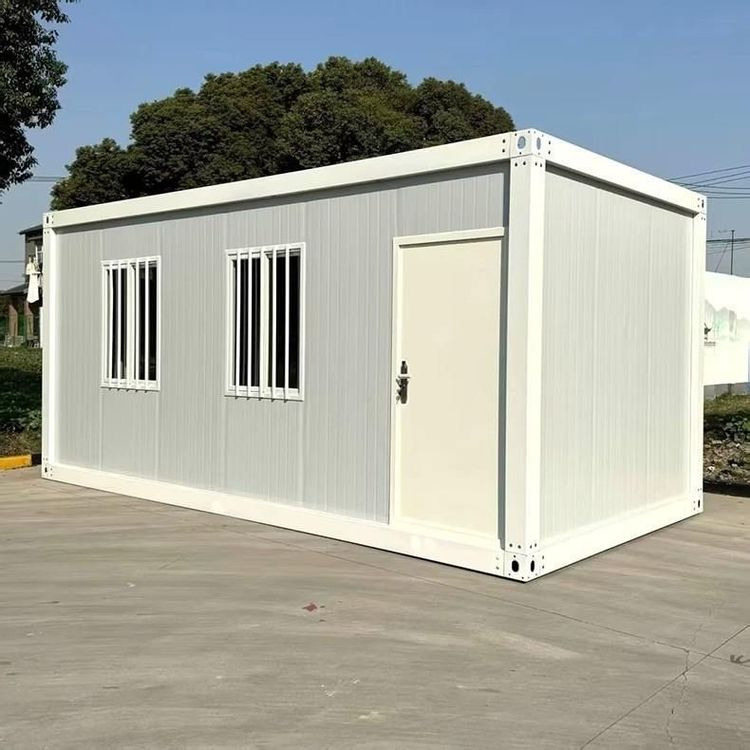
Prefabricated House Finished Product Assembly
Prefabricated house finished product assembly is a construction method that involves breaking down a building into independent modules, completing all manufacturing processes in a factory, and then transporting them to the site for assembly.

Core Processes and Characteristics
The core of prefabricated house finished product assembly lies in "factory prefabrication + on-site assembly." On the factory assembly line, processes such as wall, floor, plumbing, electrical wiring, and interior decoration are completed in one go. Each module undergoes full-process construction, including structural welding, pipeline embedding, and decoration, and leaves the factory in the form of a "finished room." At the construction site, lifting equipment is used to precisely position the modules, and workers complete the assembly through simple operations such as screwing and connecting pipelines. For example, a 16-story building in Longgang, Shenzhen, was assembled using 298 modules, taking only 120 days from the first lifting to readiness for delivery, a 60% reduction compared to traditional construction timelines.
Technical Advantages
- Significantly Shorter Construction Time: Factory production and on-site operations proceed in parallel, reducing disruptions from weather and overlapping processes. Taking the Shenzhen project as an example, an average of two floors can be assembled per day, significantly improving overall efficiency.
- High Quality Control: Standardized equipment and processes in the factory reduce human errors, ensuring uniform structural strength, pipeline layout, and decoration quality.
- Outstanding Energy-Saving and Environmental Benefits: Modular production reduces on-site wet operations (such as concrete pouring), lowering dust and noise pollution; material utilization improves, and construction waste is reduced by about 30%.
- Convenient Post-Construction Maintenance: Modules are connected using detachable methods, facilitating pipeline maintenance or space renovation and extending the building's service life.
Industrial Support Requirements
This model relies on a well-developed technical system, production system, and industrial cluster:
- Technical System: Core technologies such as module design, structural safety, and pipeline integration must be mastered to ensure stability during module transportation and assembly.
- Production System: Factories must have full-process production capabilities, including coordinated operations in automated welding, pipeline embedding, and decoration.
- Industrial Cluster: A complete industrial chain from design, production, transportation, to installation must be formed to reduce logistics costs and improve collaboration efficiency.
Prefabricated house finished product assembly represents the development direction of building industrialization, promoting the industry's transformation towards efficiency and greenness through standardized and modular design, but it requires a mature industrial foundation as a prerequisite.