
Prefabricated House Construction Steps
The construction steps of prefabricated houses mainly include three stages: factory production, transportation, and on-site construction, as detailed below:
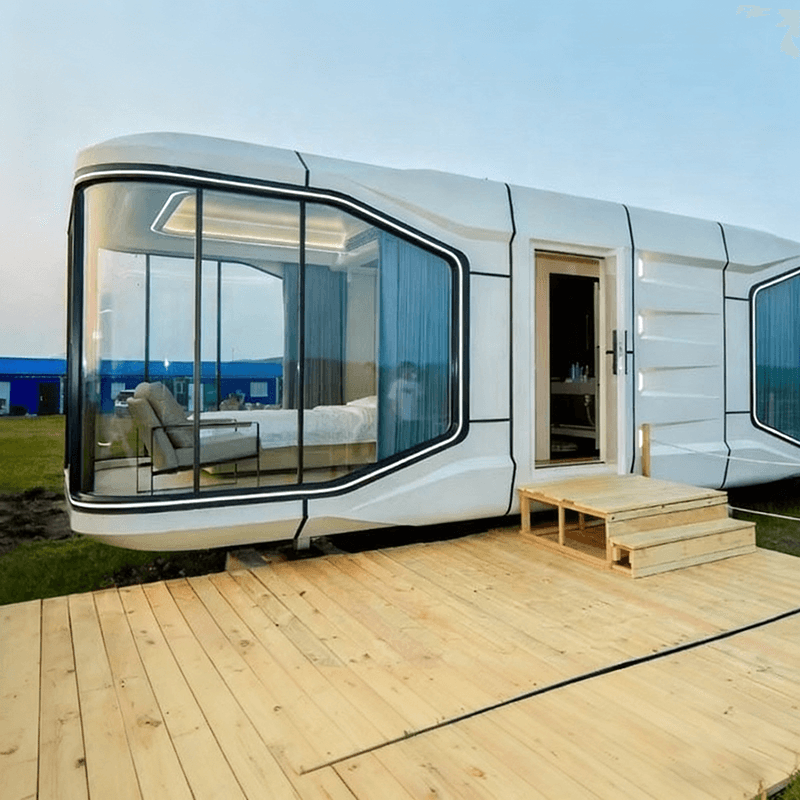
Factory Production Stage
The core advantage of prefabricated houses lies in completing the construction processes in the factory in advance. First, the entire house is divided into independent standard modules, such as a bedroom, a kitchen and bathroom unit, a corridor section, etc. Each module is designed and manufactured as a box-like structure according to standardized specifications. All processes are completed within the factory, including welding of the steel structure main body, wall installation, pre-embedding of water and electricity pipelines, installation of doors and windows, and full-house interior decoration. Additionally, the modules must pass waterproofing, fireproofing tests, and safety inspections to ensure that each module is a fully furnished, equipped with water and electricity, and complete room ready for immediate use upon leaving the factory.
Transportation Stage
The transportation stage requires consideration of both modular packaging and logistics adaptability. After customizing the house layout, style, and functions according to overseas customer needs, the factory mass-produces the modules and uniformly codes and classifies them for acceptance. The modules undergo waterproofing, anti-corrosion, and shock-proof protection treatments to adapt to the ocean shipping environment. The finished modules are transferred to domestic ports using specialized flatbed trucks, with their dimensions strictly matching international standard shipping containers for efficient loading. During ocean transportation, the house modules are shipped to over 150 countries and regions worldwide on cargo ships, with transportation times varying by destination (e.g., approximately 1 week to Southeast Asia, over 20 days to the Middle East, and about 1 month to Europe and the Americas). The entire logistics process is traceable to ensure transportation safety and efficiency.
On-site Construction Stage
Upon arrival at overseas ports, the modules are directly transported to the construction site, eliminating the need for traditional wall-building, plastering, or pipeline laying processes. The construction process primarily involves lifting and interface connection:
- Lifting and Positioning: Use cranes to lift the modules to their designated positions according to the design, ensuring precise alignment through coding or markings.
- Interface Connection: The modules are secured with locking devices, and the water and electricity pipelines are connected to form a complete building structure.
- Detail Handling: If standard floor construction is involved (e.g., installation of prefabricated bay windows or balconies), additional processes such as setting out and positioning, wall and column reinforcement tying, aluminum formwork sealing, floor slab bottom reinforcement tying, pre-embedding of water and electricity pipelines, concrete pouring, and precision leveling of the cast-in-place floor are required to ensure structural stability and flatness.
The entire construction process is similar to assembling 'LEGO blocks', significantly shortening the construction period and reducing on-site workload while ensuring building quality and precision.



