
The Entire Process of Prefabricated House Construction
The entire process of prefabricated house construction mainly includes foundation construction, installation of foundation piles and beams, modular building manufacturing and transportation, on-site assembly, backfilling and pouring, and post-treatment steps.
Foundation Construction: First, the foundation is leveled, followed by pouring a cushion layer. Then, the foundation pit is excavated to the designed depth, and a white plastic sheet is laid at the bottom of the pit to prevent water loss during subsequent concrete pouring. After that, concrete is poured to form a stable foundation, providing a solid foundation support for the entire building.
Installation of Foundation Piles and Beams: After the concrete has solidified to a certain strength, anchor plates are installed. A drill is used to bore holes at designated positions, and expansion screws are used to firmly fix the anchor plates. After that, a mobile crane is used to install the prefabricated foundation piles. Each foundation pile weighs about 5 tons, with reserved holes at the four corners for subsequent lifting operations. After the foundation piles are installed, beams are installed like building blocks according to design requirements. During the installation process, level measurements are required to ensure that the beam levelness meets the standards. After adjustment, they are fixed with nuts, and the gaps are filled with foam glue. Finally, the nut fixing points are sealed with cement to ensure the tightness and stability of the structure.
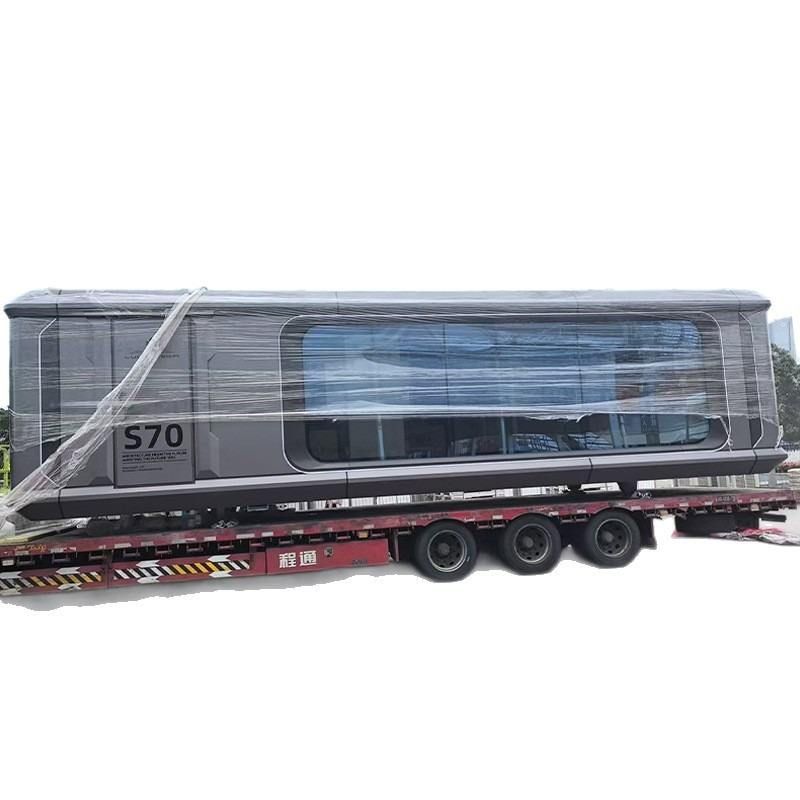
Modular Building Manufacturing and Transportation: The building is disassembled into multiple independent modules, and the manufacturing of each module is completed in the factory, including components such as ceilings, floors, water and electricity pipelines, and bathroom waterproof layers. The factory adopts parallel operations and automated production lines for production. Compared with traditional construction, this production method can significantly shorten the construction period by more than 60% and improve production efficiency.
On-site Assembly: The prefabricated modules are transported to the construction site and assembled using lifting equipment such as tower cranes. Each module comes with a detailed 'ID card' containing information such as the project name, product model, and production date. Through this information, the assembly accuracy can be controlled in millimeters, ensuring the overall quality and stability of the building.
Backfilling and Pouring: After the assembly of the foundation frame structure is completed, backfilling operations are carried out, and pouring is performed after backfilling to complete the final construction of the foundation and further enhance its stability.
Post-treatment: Grouting treatment is carried out on the gaps of all components to fill the gaps and make the structure tighter, ensuring that the entire prefabricated house structure is stable and meets the design requirements and usage standards.



