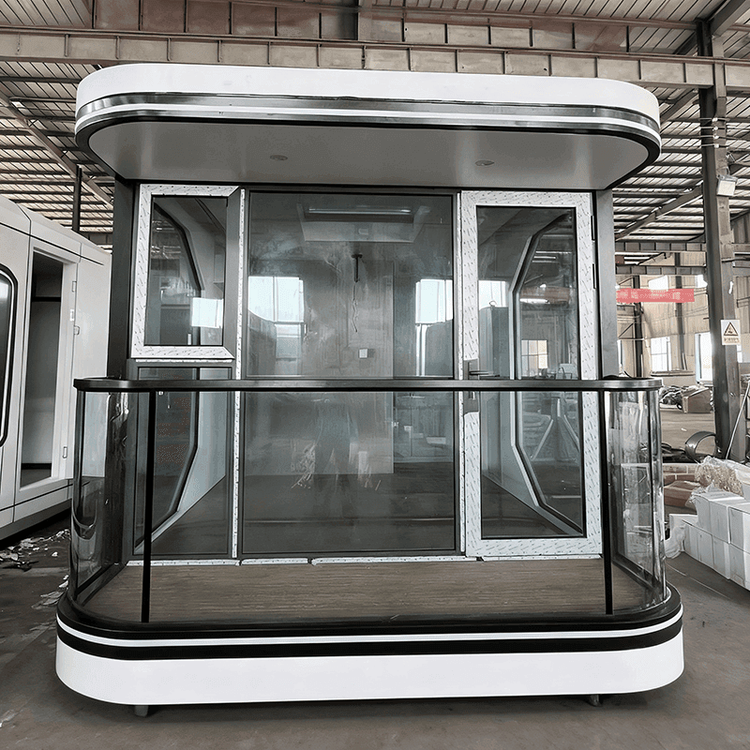
Prefabricated High-Performance Cement House
The prefabricated high-performance cement house is a prefabricated building centered around prefabricated reinforced concrete modules, offering advantages such as efficiency, cost-effectiveness, and environmental friendliness, though with limited design flexibility.

Technical Principles and Performance Advantages
The prefabricated high-performance cement house adopts a factory-prefabricated + on-site assembly model, with core components such as walls, floors, beams, and columns cast in one piece using high-precision molds. Each module integrates a steel reinforcement framework, insulation layer, waterproof layer, and pre-embedded piping structures, forming a multi-layered protective system. Its compressive strength reaches 25-30MPa (using C30-C40 concrete and Φ8-Φ12 steel reinforcement mesh), 1.5 times that of traditional brick-and-mortar structures. The walls feature reserved slots for EPS insulation layers, improving thermal insulation by 40% and achieving warmth in winter and coolness in summer. Modules are connected via pre-stressed bolts and welded steel plates, forming an integrated framework capable of withstanding wind speeds up to Category 10 and seismic intensity of 7 degrees (able to resist damage equivalent to the Wenchuan earthquake). In some cases, it has withstood typhoons of Category 12. During the Jishishan earthquake in Gansu, 2,000 relief houses were constructed in 72 hours, with simulated tests showing a displacement of only 3 centimeters.
Construction Efficiency and Cost-Effectiveness
Factory production significantly shortens construction time: a single 30㎡ module can be prefabricated in just 7 days, with on-site installation by three workers and a crane taking only 4 hours per module. A 100㎡ house can be fully assembled in 2 days, while a 200㎡ villa's main structure can be completed in 4 hours, saving 90% of the time compared to traditional construction. In terms of cost, a 120㎡ rural self-built house using traditional brick-and-mortar construction costs approximately 180,000-220,000 yuan, whereas the main module cost for a cement house is only 120,000-150,000 yuan, reducing overall costs by 30%. A 100㎡ house can be built for 100,000-120,000 yuan, 30% cheaper than brick-and-mortar construction.
Environmental Characteristics and Application Scenarios
Factory production is fully controlled, with a 95% recycling rate for offcuts. The construction site generates no dust or sewage emissions, with construction waste accounting for only 10% of that from traditional building methods. Environmentally friendly concrete and water-based paints are used, with formaldehyde emissions ≤0.05mg/m³, well below the national standard (0.1mg/m³). This technology is suitable for rural self-built houses, commercial spaces, and cultural tourism projects, such as the use of these houses to build guesthouses in the Moganshan area, which has tripled annual income.
Limitations
Design flexibility is relatively low, with special shapes like rounded balconies requiring an additional 20% customization fee. It is essential to choose reputable brands (such as Broad Homes) with a 70-year warranty and seismic reports to ensure quality and safety.