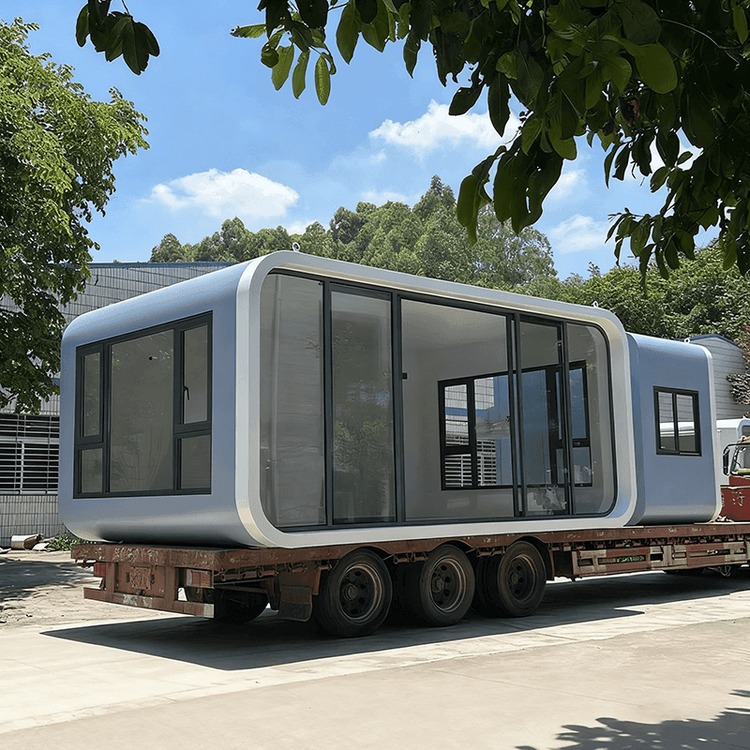
Prefabricated Container Mobile Toilet
A prefabricated container mobile toilet is a mobile sanitation facility that uses a container as its carrier, integrating toilet functional modules. It features overall prefabrication, ready-to-use installation via lifting, and relocatable and reusable characteristics.

Core Features
Prefabricated container mobile toilets adopt factory-based overall prefabrication processes, where the main structure and functional modules (such as sanitary ware and sewage systems) are assembled in the factory. On-site, they only require lifting and positioning to be put into use, significantly shortening the construction cycle. Their relocatability supports repeated disassembly and reuse in different locations, making them suitable for temporary or semi-permanent scenarios. Additionally, modular design allows for the addition or removal of functional units (such as management rooms and barrier-free facilities) based on actual needs, enhancing space utilization.
Application Scenarios
Covering both fixed and semi-fixed locations:
- Scenic Area Support: Addressing the toilet demand during peak tourist periods and reducing damage to the natural environment;
- Municipal Sanitation: Serving as temporary public toilet supplements to respond to emergencies or construction area needs;
- Construction Sites: Meeting the daily needs of workers and avoiding the sanitation issues of traditional dry toilets;
- Large-Scale Events: Quickly deployed at temporary gathering places such as sports events and music festivals;
- National and Provincial Road Service Areas: Providing convenient sanitation services for long-distance drivers and reducing construction costs.
Technical Routes and Environmental Advantages
The product line covers various technical types:
- Flush Type: Relies on water supply and drainage networks, suitable for scenarios with infrastructure;
- Packing/Microbial Degradation Type: Uses degradable bags or microorganisms to decompose feces, achieving zero sewage discharge and suitable for areas without a drainage network;
- Foam Sealing Type: Uses foam to cover excreta, reducing odors and water consumption.
Among them, microbial degradation and waterless packing technologies are widely used in ecologically sensitive areas or water-scarce regions due to their outstanding environmental performance.
Materials and Customization
The main materials include steel structures, stainless steel, color-coated steel, and aluminum alloys, which should be selected based on the usage environment:
- Corrosion Resistance: Galvanized sheets and aluminum-plastic panels are preferred in coastal or high-humidity areas;
- Lightweight: Color-coated steel and light steel materials facilitate transportation and lifting;
- Aesthetics: Anticorrosive wood and fiberglass-reinforced plastics are suitable for scenic areas with high appearance requirements.
Some merchants support customization of size, color, and functional modules according to demand, but prices are subject to specific merchant quotations.
Market and Price References
Competition among enterprises is fierce, and product prices vary significantly:
- Basic Models: For example, the mobile toilet container house from Suzhou Xinchao Yue Integrated Housing Co., Ltd. is priced at approximately 190 yuan (possibly a simple module);
- Mid-to-High-End Models: The scenic area toilet from Yiwu Haoju Trading Co., Ltd. is priced at 16,800 yuan, including complete functions and decorations;
- Customized Models: Products from Shandong Mingqi Security Technology Co., Ltd. start at 1,300 yuan, support processing and customization, have a one-year warranty, and a lifespan of up to 30 years.
When choosing, it is necessary to comprehensively consider the budget, usage frequency, and long-term maintenance costs.