
Prefabricated Cement House Shop
A prefabricated cement house shop is a commercial building form where components are prefabricated in a factory and assembled on-site. It features fast construction, low cost, and high flexibility, and is widely used in rural areas, construction sites, shops, and other scenarios.
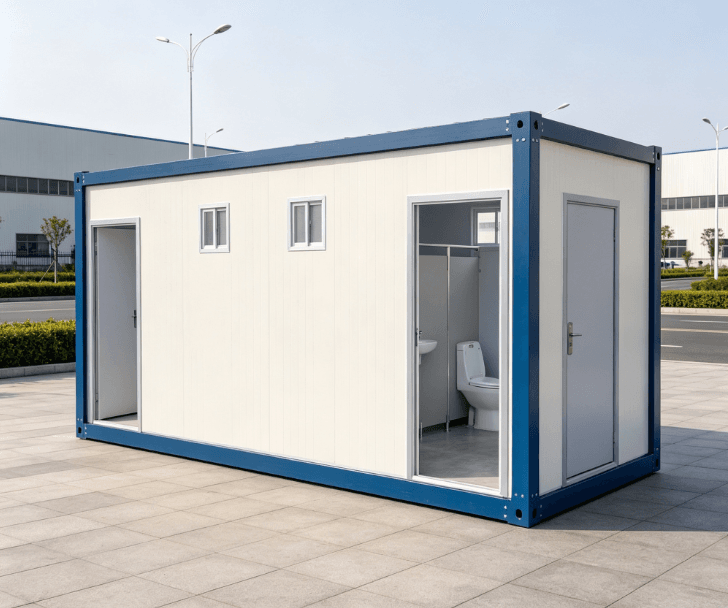
Basic Concepts and Material Structure
Prefabricated cement house shops are produced by factory-based manufacturing of cement components (such as walls, floors, beams, and columns), which are then transported to the site for rapid assembly. The core materials include cement, sand, gravel, and steel bars, which are mixed and poured to form the structural main body. The structural types are mainly divided into frame structures (with beams and columns bearing the load, allowing flexible spatial layouts) and panel structures (assembled with prefabricated panels, making construction simpler), suitable for shops of different scales and functions.
Manufacturing Process and Advantages
The manufacturing process covers design, mold making, concrete mixing, pouring and vibration, curing, transportation, and assembly. Factory-standardized production allows for strict quality control and reduces on-site construction errors. Its core advantages include:
- High Construction Efficiency: On-site assembly time is reduced by more than 50% compared to traditional buildings, making it particularly suitable for urgent housing needs.
- Cost Control: The cost of a standard unit is approximately tens of thousands to hundreds of thousands of yuan, with unit prices ranging from 260 yuan per square meter (for bulk purchases) to 1,100 yuan per square meter (for customized configurations), significantly lower than brick-and-mortar structures.
- Stable Quality: The factory environment avoids weather interference, and concrete curing conditions are optimized, resulting in more uniform structural strength.
- High Flexibility: It supports customization of dimensions (such as width, length, and number of floors), with common standard sizes being 3m × 6m, 4m × 8m, and 5m × 10m, meeting the diverse needs of small convenience stores to medium-sized restaurants.
Application Scenarios and Price Differences
This building form is widely used in rural self-built shops, temporary construction site housing, scenic area commercial streets, and other scenarios. Price differences are mainly influenced by size, configuration, and purchase volume:
- Small-scale Needs: For example, a 30-square-meter single-room shop with basic configuration may have a total price as low as tens of thousands of yuan.
- Large-scale Purchases: Bulk orders (such as over 1,000 square meters) can have a unit price as low as 260 yuan per square meter, suitable for chain brands or uniformly developed commercial projects.
- High-end Customization: If insulation layers, decorative panels, or smart systems are added, the unit price may exceed 1,500 yuan per square meter.
Precautions
When choosing, attention should be paid to the merchant's qualifications, component transportation conditions, and on-site foundation treatment requirements to ensure structural safety and durability.



