
Portable Toilet
A portable toilet is a facility that can be moved as a whole and provides toilet services to the public, suitable for various locations and featuring multiple types and characteristics.
I. Basic Definition and Suitable Locations
A portable toilet (Portable toilet) refers to a facility that can be moved as a whole and set up at fixed or temporary locations, primarily providing toilet services to the public and clients. It is suitable for a wide range of locations, including stations, docks, tourist attractions, villa areas, newly built residential communities, large construction sites, squares, densely populated public places, and bustling commercial streets. These locations often require flexible deployment of portable toilets due to high foot traffic, high costs of constructing fixed toilets, or limited space.
II. Structural Composition and Material Evolution
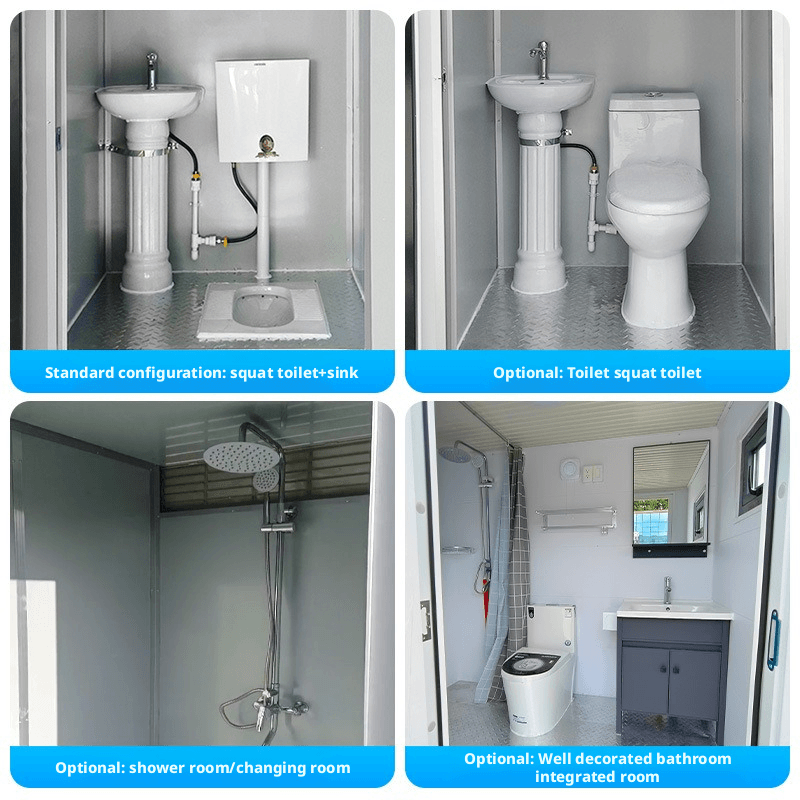
A portable toilet generally consists of a fecal sewage storage tank (or disposal unit), flooring, sanitary fixtures, walls, washing facilities, water tanks, roofs, and mobile units. Early portable toilets were mostly made of wood, with a simple structure but prone to absorbing odors. With technological advancements, materials such as fiberglass and polyethylene have been gradually adopted. These materials are corrosion-resistant, easy to clean, and have good sealing properties, significantly improving the practicality and hygiene of portable toilets.
III. Type Classification
- By structural form: Divided into single-unit portable toilets (independent units suitable for small-scale needs) and composite-structure portable toilets (multiple units combined to meet large-scale needs).
- By mobility method: Includes lifting and handling types (relying on mechanical handling), powered, and towed types (capable of self-movement or being towed by vehicles).
- By sewage treatment method: Divided into water-flush and waterless suction types (relying on water sources or regular suction), circulating water-flush types (water resource recycling), and dry-pack types (fecal packing treatment, no water required).
IV. Characteristics and Design Principles
The core characteristics of portable toilets are mobility, modularity, and ease of transportation, allowing repeated use at different locations. Their design follows the following principles:
- Mobile convenience and economic durability: Lightweight yet sturdy structures reduce transportation and deployment costs.
- Environmental protection and ecological benefits: Adopt water-saving technologies or waterless treatment to reduce pollution emissions.
- Enhanced efficiency and humanitarian promotion: Optimize internal layout and sanitary facilities to improve user experience.
V. Special Designs and Functional Expansions
Some portable toilets blend into the environment through exterior design, such as brick-patterned flat-roof types (galvanized steel frame structure, orange brick-patterned exterior walls, durable for over 15 years) and pastoral-style types (thatched roofs, rain-proof areas, public washbasins, and beauty mirrors), combining practicality with aesthetics.



