
Portable Toilet & Mobile Toilet
A portable toilet is a facility that can be moved as a whole to provide public restroom services. It has the advantages of mobility, modularity, and ease of transportation, and comes in various structural forms, mobility methods, and sewage treatment approaches.
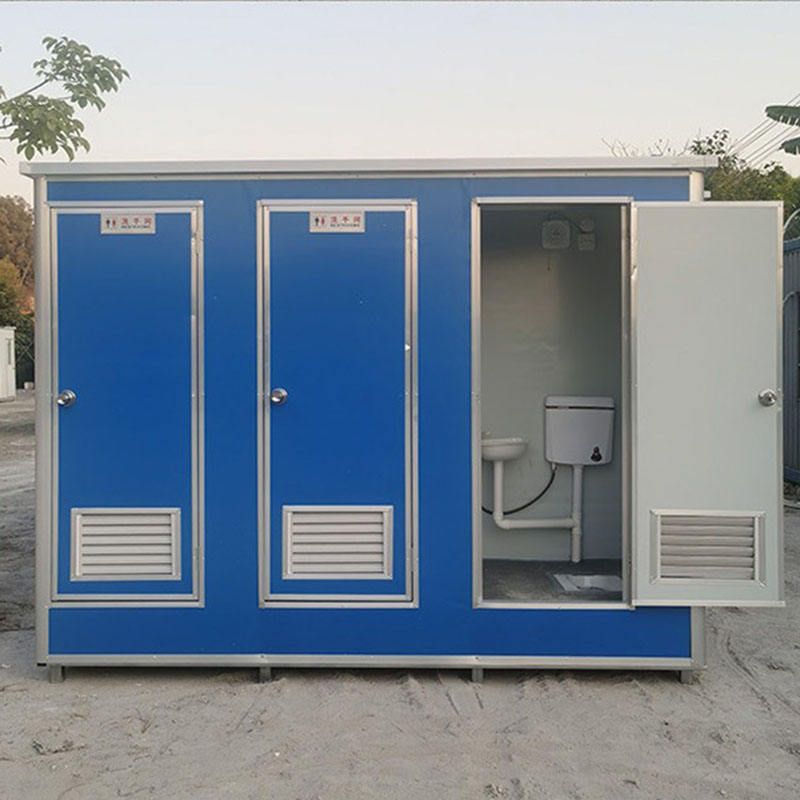
Portable toilets are generally composed of fecal sewage storage tanks (or fecal sewage treatment devices), floor slabs, sanitary ware, walls, washing equipment, water tanks, roofs, and mobility devices. Their mobility allows them to be easily transported to any location where a toilet needs to be set up and can be used repeatedly.
In terms of structural form, portable toilets can be divided into single-structure portable toilets and composite-structure portable toilets. Single-structure portable toilets are relatively independent and have a simpler structure; composite-structure portable toilets may be composed of multiple parts and may have richer functions.
Based on mobility methods, there are lifting and handling-type portable toilets, which usually require lifting equipment or manual handling for movement; power-driven and towed-type portable toilets have their own power or can be moved by vehicle towing, making movement more convenient.
Regarding sewage treatment methods, portable toilets are classified into water-flush and non-water-flush suction-type portable toilets, circulating water-flush portable toilets, and dry-packing portable toilets. Water-flush and non-water-flush suction-type portable toilets: the former relies on water flushing for cleaning, while the latter treats feces through suction; circulating water-flush portable toilets can recycle flushing water to save water resources; dry-packing portable toilets dry-pack feces without using water.
In addition, there are compact and intelligent eco-friendly portable public toilets equipped with complete internal fecal collection systems, hand-washing sinks, smart mirrors, and breathing lights. They are not restricted by fixed buildings and can be flexibly scheduled according to the density of pedestrian traffic and event locations. Whether in urban business districts, large-scale exhibitions, or remote outdoor scenic spots, they can be quickly deployed to promptly meet people's restroom needs.



