
Portable Quick-Assembly Container House
The portable quick-assembly container house is a habitable or office building transformed from a container as its basic structural module. It features mobility, detachability, environmental friendliness, flexibility, and low cost, and is widely used in temporary housing, creative spaces, post-disaster emergency buildings, and other fields.
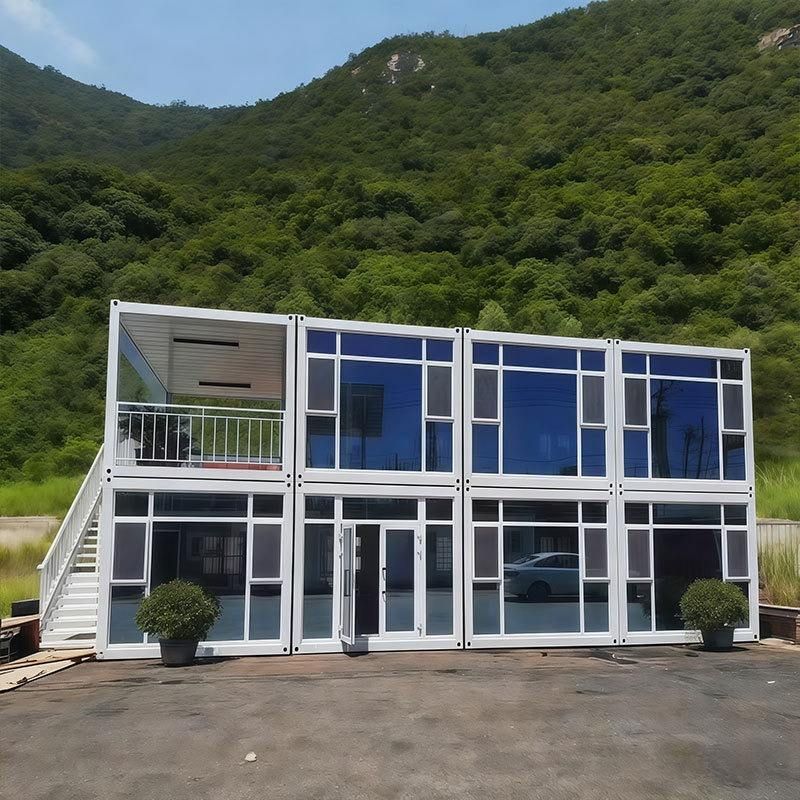
Core Structure and Specifications
The portable quick-assembly house is based on a standard container for modification, with common dimensions of 3 meters in width, 6 meters in length, and 2.8 meters in height. The interior space can be adjusted according to needs. Its main structure is made of high-strength steel, which, after anti-corrosion treatment, provides resistance to wind, earthquakes, and moisture, with a service life of up to 15-20 years. The modular design allows for space expansion through assembly, such as vertically stacking two containers to form a two-story structure or horizontally connecting them to create larger office or living areas.
Main Features
Mobility and Flexibility
Container houses can be quickly relocated to different locations using lifting equipment without dismantling the foundational structure, making them suitable for scenarios requiring frequent position adjustments (e.g., temporary construction site offices, exhibition event housing). After disassembly, only the container modules need to be transported, significantly reducing relocation costs.Environmental and Cost Advantages
The material recycling rate exceeds 80%, reducing construction waste; factory prefabrication shortens on-site construction time, reducing labor costs by approximately 40%. Compared to traditional concrete buildings, overall costs can be reduced by 30%-50%.Rapid Deployment Capability
Standardized components support “plug-and-play” functionality, such as emergency medical facilities that can be set up within 72 hours, meeting the needs of post-disaster relief or temporary hospitals during pandemics.
Typical Application Scenarios
- Temporary Facilities for Large Events: For example, the 2026 Nagoya Asian Games in Japan used container houses to build the Athletes' Village, balancing functionality and environmental requirements.
- Cultural and Tourism Creative Spaces: In Shanting District, Zaozhuang City, Shandong Province, China, containers have been transformed into characteristic homestays, creating a differentiated tourism experience by integrating with natural landscapes.
- Commercial Innovation Applications: Some brands have converted them into 24-hour self-service fitness pods, unmanned retail stores, etc., exploring new retail models.
- Emergency Rescue Field: In earthquakes, floods, and other disasters, container houses serve as temporary shelters or medical stations, providing safe and reliable living support.
Technological Development Trends
With advances in material science, the application of lightweight aluminum alloy containers and composite insulation materials further enhances energy efficiency; the integration of intelligent systems (such as solar power and IoT monitoring) makes them more adaptable to modern living needs. In the future, container houses are expected to play a greater role in cutting-edge fields such as modular cities and space habitats.



