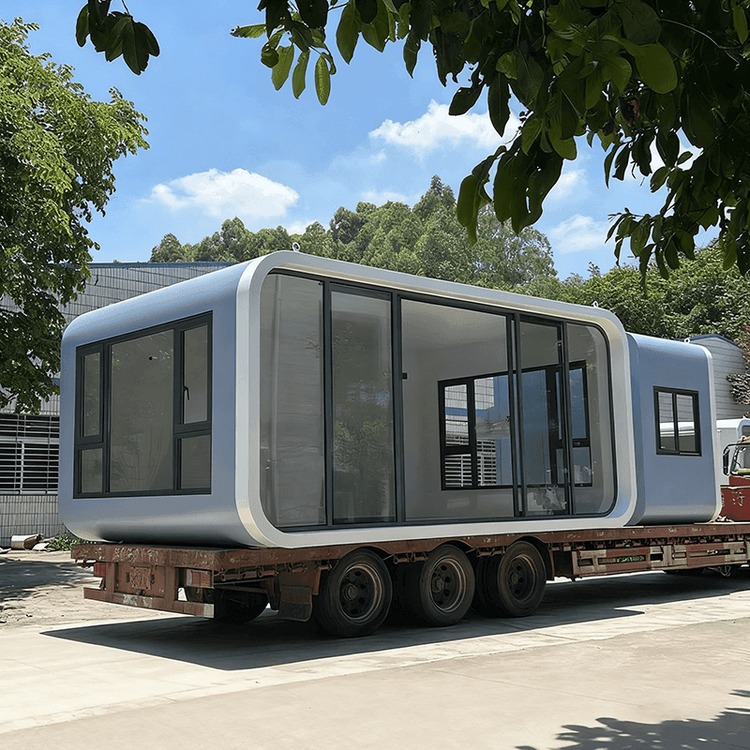
Portable Outdoor Simple Toilet
A portable outdoor simple toilet, also known as a mobile toilet, is a facility that can be moved as a whole to provide public toilet services.

Applicable Places: Mobile toilets are suitable for a variety of scenarios, including stations, docks, tourist attractions, villa areas, newly built residential communities, large construction sites, squares, as well as densely populated public places and bustling commercial streets. These places often have high demands for sanitation facilities due to large foot traffic or temporary needs, and the flexibility and convenience of mobile toilets precisely meet these requirements.
Structural Composition: Mobile toilets are generally composed of multiple parts, including fecal sewage storage tanks (or fecal sewage treatment devices), floor slabs, sanitary ware, walls, washing equipment, water tanks, roofs, and mobile devices. These components work together to ensure the normal use and hygiene of the toilet.
Classification Methods:
- By structural form: They can be divided into single-structure mobile toilets and composite-structure mobile toilets. Single-structure toilets are usually simpler and suitable for small-scale needs; composite-structure toilets are more complex and may contain multiple functional areas, suitable for large-scale or special-need places.
- By mobility method: They can be divided into lifting and handling-type mobile toilets, as well as powered and trailer-type mobile toilets. Lifting and handling types are suitable for short distances or scenarios requiring frequent movement; powered and trailer types are more suitable for long distances or fixed-route movement.
- By sewage treatment method: They can be divided into water-flush and waterless-flush suction-type mobile toilets, circulating water-flush type mobile toilets, and dry-packing type mobile toilets. Water-flush types are suitable for places with a water supply; waterless-flush suction types use suction equipment to treat feces and are suitable for water-scarce areas; circulating water-flush types reduce water consumption by recycling water resources; dry-packing types treat feces by packing and do not require a water source, suitable for extremely water-scarce or environmentally demanding places.
Features and Advantages: Mobile toilets have the advantages of being movable, combinable, and easy to transport. They can be conveniently transported to any place where toilets need to be set up and can be used repeatedly, greatly reducing construction costs and maintenance difficulties.