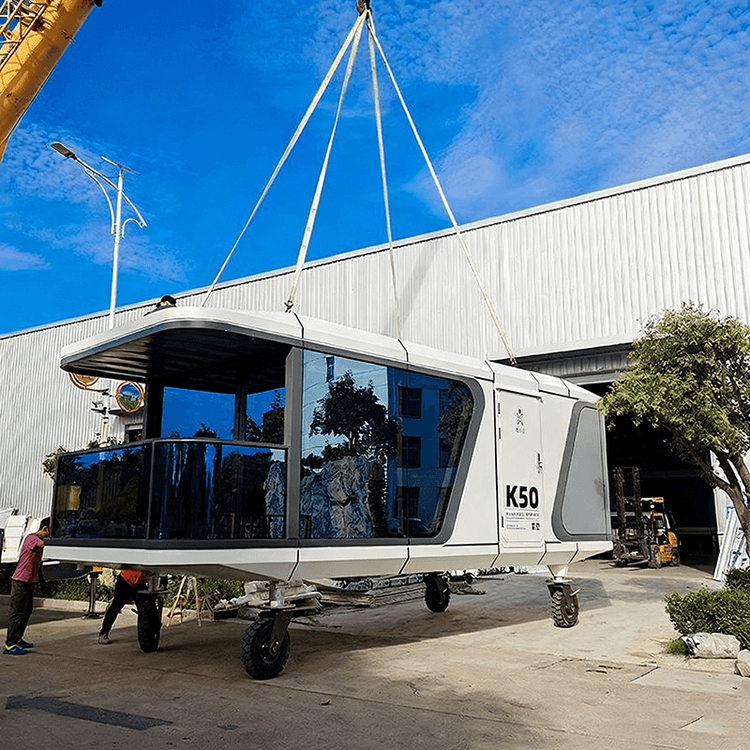
Plastic Barrier-Free Mobile Toilet
There is currently no unified standard definition for plastic barrier-free mobile toilets, but reasonable inferences can be made by combining material characteristics with barrier-free design requirements. Their core features may include lightweight materials, functional adaptability, and potential barrier-free auxiliary designs.

Material and Structural Foundations
The materials used in plastic barrier-free mobile toilets are typically lightweight and durable plastics such as polyethylene (PE) and fiberglass-reinforced plastic (FRP). For example, products like eco-friendly plastic toilets and plastic direct-discharge toilets provided by Guangzhou Kening Environmental Protection Technology Co., Ltd. all use these materials, which are corrosion-resistant, easy to clean, and lightweight, facilitating transportation and installation. These materials not only reduce the overall weight of the toilet but also provide basic conditions for barrier-free design, such as the ability to design wider entrances or lower operation panels to accommodate wheelchair users or individuals with mobility impairments.
Functional Adaptability and Barrier-Free Potential
The functional designs of existing plastic mobile toilets may indirectly support barrier-free use:
- Lightweight and Ventilation Design: The new lightweight plastic mobile toilets for 2026 emphasize "lightweight design" and "ventilation design" and are equipped with gravity-flush sewage tanks and foot pumps. This design may simplify the operation process (e.g., foot-operated flushing) to reduce usage difficulty, indirectly enhancing the barrier-free experience.
- Independent Water and Waste Tanks: Portable plastic toilets come with built-in water and waste tanks, eliminating the need for external water and electricity connections, and are equipped with safety door locks and ventilation louvers. If further optimized, such as lowering the height of the water tank and adopting a threshold-free entrance, they could more directly meet barrier-free requirements, but this would require verification with specific products.
Application Scenarios and Barrier-Free Needs
Mobile toilets are widely used in construction sites, outdoor events, parks, and other venues, where there is a clear demand for barrier-free design, such as wheelchair passage space, handrails, and non-slip floors. However, current search results do not explicitly mention whether plastic mobile toilets are equipped with such auxiliary facilities as standard. To confirm the barrier-free configurations of specific products (e.g., entrance width, handrail height, internal space dimensions), it is recommended to contact the supplier directly (e.g., Guangzhou Kening Environmental Protection Technology Co., Ltd., phone: 176 2013 4798) for detailed parameters.
Summary and Recommendations
The design of plastic barrier-free mobile toilets should balance material advantages with barrier-free specifications, such as using lightweight plastics to reduce structural weight while incorporating details like low-positioned operation panels and barrier-free entrances. Currently, some products on the market may already possess partial barrier-free potential, but full adaptability requires further optimization or customization. If purchasing or customizing such products, it is advisable to consult professional suppliers first to clarify barrier-free design standards and actual needs.