Mobile Toilets for Outdoor Scenic Areas
Mobile toilets for outdoor scenic areas are designed as movable facilities to meet temporary and periodic toilet needs in places such as scenic spots, featuring flexible deployment, environmental protection, and durability.

I. Basic Components and Structural Types
The core components of mobile toilets include fecal wastewater storage tanks (or disposal units), floor slabs, sanitary fixtures, walls, washing equipment, water tanks, roofs, and mobile devices. Based on structural form, they can be divided into monolithic structures (independent units) and composite structures (multi-unit combinations); by mobility method, they are classified as hoisting/handling types (requiring mechanical assistance) and powered/trailer types (with self-contained power or towable); and according to wastewater treatment method, they include flush types (requiring a water source), waterless suction types (with periodic cleaning of fecal storage tanks), recirculating flush types (with wastewater purification and reuse), and dry-pack types (with feces collected in biodegradable bags).
II. Functional Characteristics and Design Principles
- Flexibility and Durability: Lightweight materials (such as metal carved panels and galvanized steel frames) are used to reduce weight, facilitating transportation and repeated use. For example, a four-stall toilet measuring 4 meters in length and 2.3 meters in width, with exterior walls made of thermal-insulating metal carved panels, can have a lifespan of over 15 years.
- Environmental Protection: Dry-pack types do not require a water source, reducing pollution; recirculating flush types achieve water resource reuse through filtration systems, meeting ecological requirements.
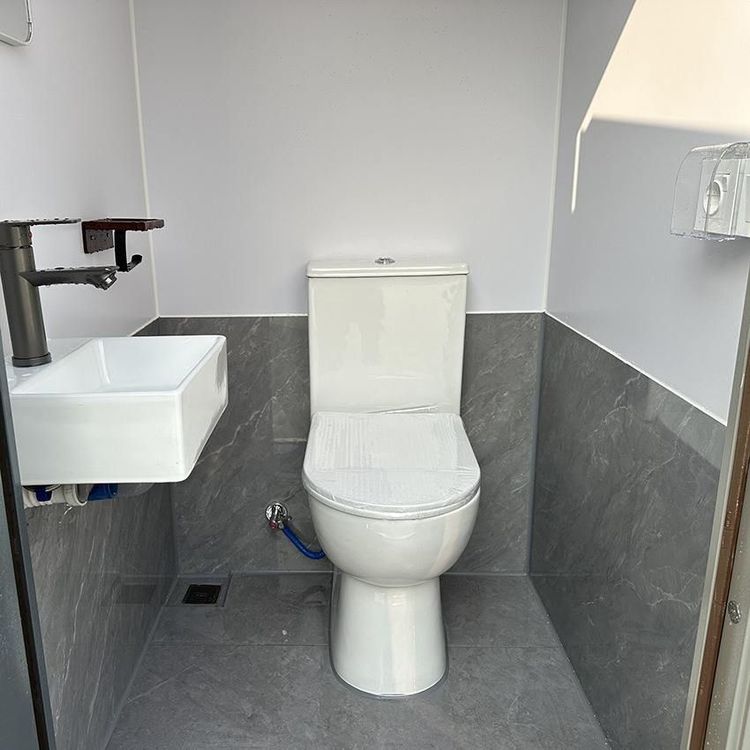
- Human-Centered Design: Internally equipped with independent stalls, urinals, and public handwashing areas, some models feature two stalls each for men and women, balancing privacy and efficiency.
- Adaptability: Special designs (such as brick-patterned flat roofs) can blend into the scenic environment while meeting wind and rain resistance requirements.
III. Typical Application Scenarios and Costs
Mobile toilets are suitable for scenic spots with high foot traffic but weak infrastructure, as well as temporary event venues. Taking a four-stall model as an example, the basic configuration (including two male stalls, urinals, and a column sink) costs less than 20,000 yuan, while high-end models (such as those with galvanized steel frames) are more expensive but offer greater durability and lower long-term costs.
IV. Key Design Specifications
Design should adhere to the principles of mobility convenience, economic durability, environmental ecology, and efficiency enhancement, with a focus on controlling height and width to meet transportation requirements. Mobile devices (such as wheels and tow hooks) must be complete and reasonable to ensure safety and operational convenience.