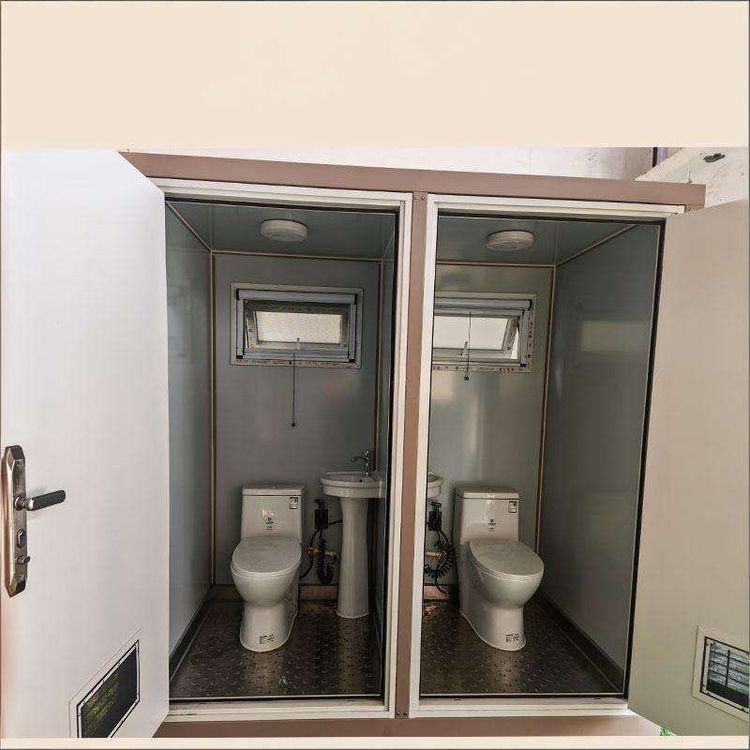
Environmental Assessment of Outdoor Portable Toilets
The environmental assessment of outdoor portable toilets primarily focuses on two core dimensions: the impact of the treatment system on the environment and environmental cost-effectiveness. The specific manifestations are as follows:

Environmental Friendliness of the Treatment System
Modern outdoor portable toilets generally employ biodegradation technology to treat excreta. The core principle involves converting waste into harmless organic substances (such as carbon dioxide, water, and a small amount of humus) through microbial decomposition. This process avoids issues like soil compaction and water eutrophication caused by direct waste discharge from traditional toilets, making it particularly suitable for ecologically sensitive areas (such as nature reserves and scenic spots). For example, some portable toilets accelerate decomposition by adding specific bacterial strains, enabling waste treatment within 24 hours and significantly reducing pollutant retention time.
Additionally, water-saving design is another key environmental indicator. Traditional toilets require 6-10 liters of water per flush, whereas portable toilets reduce water consumption to 2-3 liters per flush by optimizing flushing systems (such as vacuum suction and foam sealing technology), which is only one-third of that of traditional toilets. This design offers significant advantages in arid regions or scenarios with scarce water resources, aligning with sustainable development principles.
Environmental Cost-Effectiveness
Environmental assessment not only focuses on technical performance but also evaluates long-term usage costs. Reusability is an important indicator: some portable toilets adopt a modular design, supporting overall lifting and relocation (such as products from Anhui Zhisheng Environmental Engineering Co., Ltd.), enabling reuse across different projects and avoiding waste from one-time construction. According to actual measurement data, such toilets can save nearly ten thousand yuan in foundation construction costs through reuse—traditional toilets require concrete foundation pouring, while portable toilets only need ground leveling for installation, significantly reducing initial investment.
Solid waste management efficiency also directly impacts environmental performance. Biodegradation technology converts excreta into organic fertilizer or directly discharges it as harmless gases, reducing carbon emissions from solid waste transportation and treatment processes. Some high-end models are also equipped with solar power systems, further reducing energy consumption and forming a closed loop of "resource-treatment-reuse".
In summary, the environmental performance of outdoor portable toilets achieves dual improvements through technological innovation and cost optimization, meeting both environmental friendliness requirements and economic feasibility, making them a typical case of green transformation in public facilities.