Outdoor Mobile Toilet Design for Rural Areas
The design of outdoor mobile toilets in rural settings should focus on structure, functionality, materials, and environmental adaptability, with the core goal of balancing durability, maintenance costs, and user experience.

1. Structure and Material Selection
The basic structure of rural mobile toilets is recommended to use an integrated steel frame, combined with three-proof panels (waterproof, corrosion-resistant, and rust-resistant) to construct the box. The steel frame should be enhanced with hot-dip galvanizing for corrosion resistance. The internal compartments should adopt molding processes to ensure airtightness and prevent leakage. Material weather resistance is crucial: the difference in temperature resistance between ordinary color-coated steel plates and fiberglass composite materials can exceed 20°C. In extremely cold or hot regions, fiberglass composite materials should be prioritized to extend service life.
2. Drainage and Ventilation Design
The bottom should be designed with a 1.5° inclined anti-leakage slope to accelerate liquid flow into the sewage collection tank and prevent water accumulation. The ventilation system should be equipped with a forced exhaust channel, using fans to create negative pressure airflow and reduce odor retention. Ventilation power should match the environmental load, with a recommended air exchange rate of no less than 3 times per hour per cubic meter to ensure air circulation.
3. Sewage System Adaptation
Choose sewage disposal methods based on usage scenarios:
- Direct discharge structure: High maintenance frequency but low cost, suitable for short-term events (e.g., fairs, temple festivals);
- Closed system (with a macerator pump): Requires electricity but is suitable for long-term fixed installations, ideal for densely populated or high-frequency usage areas.
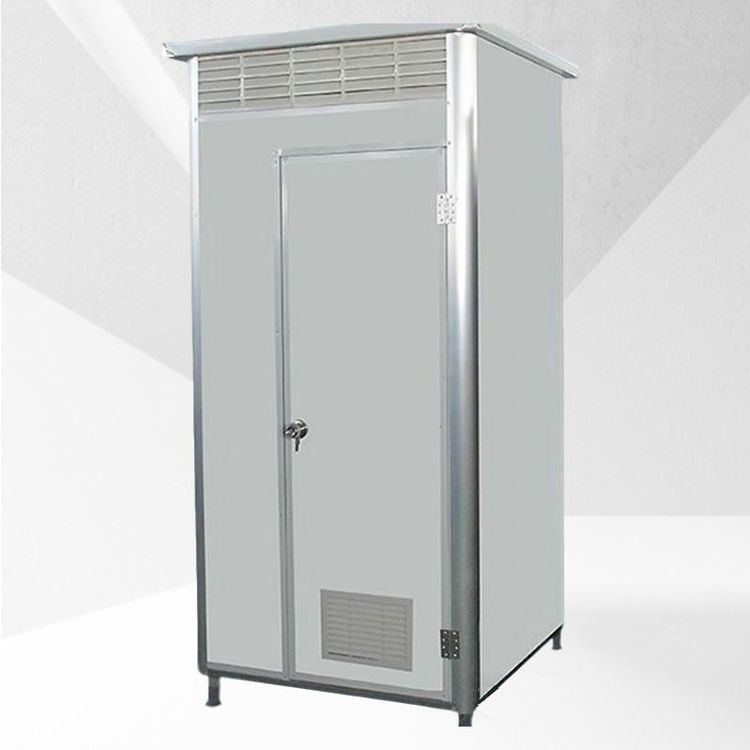
For example, single-person dry toilet dimensions can be 1.1×1.1×2.35 meters or 1.3×1.3×2.35 meters, and can be equipped with fecal tanks or shower functions to meet diverse needs.
4. Appearance and Functional Optimization
The appearance can incorporate a rustic style, such as a ridged roof with thatch and a front section featuring a rain-proof area, public sinks, and mirrors to enhance aesthetics and practicality. Anti-slip design should focus on matching the bottom texture with the slope angle. In windy areas, a low-center-of-gravity, flat square structure is recommended to enhance stability.
5. Cost and Customization Options
Prices range from 900 yuan (simple rural renovation model) to 6,225 yuan (triple direct discharge engineering model), with support for customization of color, size, and functional modules (e.g., single-person showers, dual direct discharge combinations). Customization should consider actual usage scenarios to balance initial investment and long-term maintenance costs.
The design of rural mobile toilets should prioritize practicality and cost-effectiveness, meeting diverse needs through modular design, weather-resistant material selection, and functional adaptation while reducing long-term maintenance pressures.