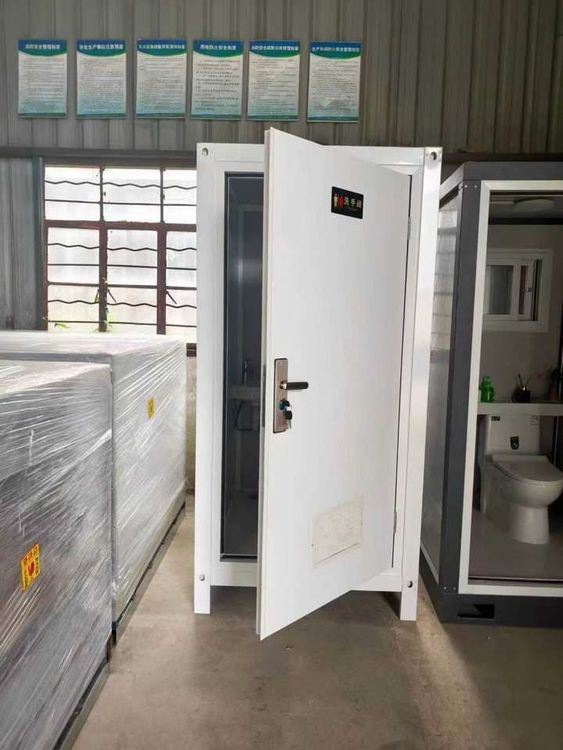
Outdoor Mobile Toilet Basin
The basin configurations of outdoor mobile toilets vary depending on the product model and design. Common configurations include combinations of squatting positions and urinals, and the specifics should be determined based on the product descriptions provided by the equipment manufacturers.

Some outdoor mobile toilets adopt a gender-separated design. For example, the gender-separated mobile toilets produced by Dezhou Hongtu Metal Products Co., Ltd. are equipped with one squatting position each for men and women, with a hand-washing area set up in the middle. This design achieves gender separation through physical partitions, with a balanced number of squatting positions, making it suitable for scenarios with relatively even foot traffic. The centralized setup of the hand-washing area optimizes space utilization efficiency.
For scenarios with high foot traffic or significant gender ratio differences, some products adjust the types and quantities of basins. For instance, in a certain four-squatting-position mobile toilet, the men's toilet is configured with two squatting positions and one urinal, while the women's toilet has two squatting positions. Such designs enhance male usage efficiency by adding urinals while maintaining the number of female squatting positions, making them suitable for public areas with higher male usage frequencies, such as sports event venues or temporary gathering places.
The configurations of classic outdoor mobile toilets focus more on covering basic functions. For example, in the classic men's-three-women's-two model, the women's toilet is clearly equipped with two squatting positions, and although the basin type in the men's toilet is not detailed, it can be inferred from the naming convention to be three squatting positions or a combination including urinals. Such designs adhere to the principle of "sufficiency" and reduce manufacturing costs through simplified configurations, making them suitable for temporary scenarios with limited budgets or low usage frequencies.
It should be noted that all configuration information is sourced from the product descriptions provided by equipment manufacturers, and actual usage may vary due to production batches, customization requirements, or regional standards. When making a purchase, it is recommended to consider the foot traffic, gender ratio, and spatial conditions of the usage scenario, prioritize products that have passed quality certifications, and request detailed configuration lists and maintenance instructions from suppliers to ensure that the equipment functions meet expected requirements.