Outdoor Mobile Toilet
An outdoor mobile toilet is a facility that can be moved as a whole, set up in outdoor locations, and provides toilet services to the public. It is introduced from multiple aspects below:

I. Structural Composition A mobile toilet generally consists of a fecal sewage storage tank (or fecal sewage treatment device), floor slab, sanitary ware, walls, washing equipment, water tank, roof, and moving device. These components work together to create a complete toilet environment. For example, the fecal sewage storage tank is used to collect and treat excreta, while the sanitary ware includes toilets and squat pans for people's convenience.
II. Type Classification
- By structural form: It can be divided into single-structure mobile toilets and composite-structure mobile toilets. The single-structure type is relatively simple and highly independent; the composite-structure type may be composed of multiple parts and has more complex functions.
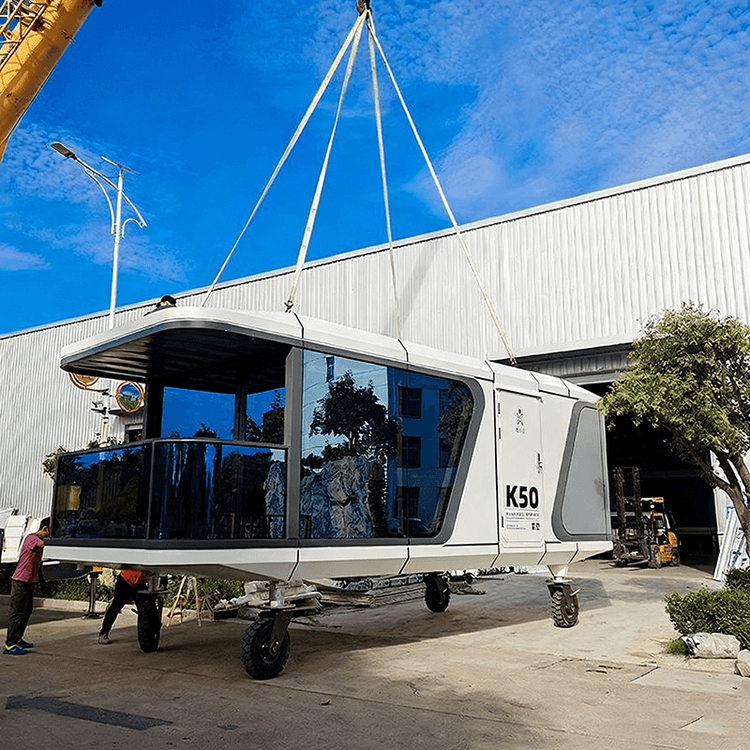
- By moving method: It is classified into lifting and handling mobile toilets, and powered and towed mobile toilets. Lifting and handling mobile toilets usually require external equipment for movement; powered and towed mobile toilets have a certain degree of autonomous movement capability and can be moved by power drive or towing.
- By sewage treatment method: It includes water-flush and waterless-flush suction mobile toilets, circulating water-flush mobile toilets, and dry-packing mobile toilets. Water-flush and waterless-flush suction mobile toilets treat excreta through water flushing or suction; circulating water-flush mobile toilets recycle water to save water resources; dry-packing mobile toilets package excreta in a dry form for easy subsequent cleaning.
III. Characteristics and Advantages Outdoor mobile toilets have the characteristic of being easily transported to any location where a toilet needs to be set up and can be used repeatedly. They also have the advantages of being movable, combinable, and easy to transport, allowing for flexible adjustment of their positions and quantities according to actual needs to meet the toilet demands of different locations. For example, at temporary event sites or in remote areas, mobile toilets can be quickly deployed to provide convenient toilet conditions for people.