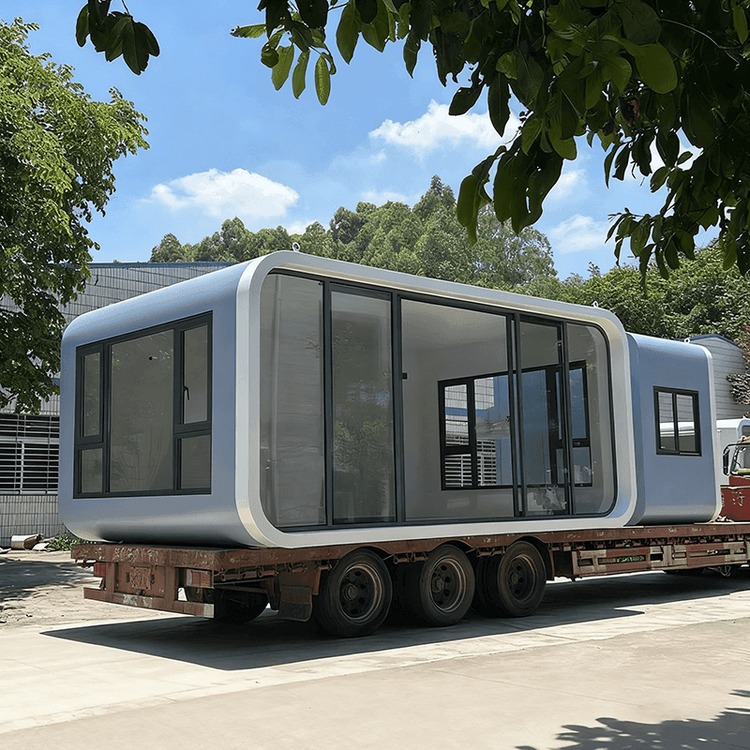
Outdoor Integral Mobile Toilet
An outdoor integral mobile toilet is a facility that can be moved as a whole and provides toilet services to the public. It is suitable for various places and has multiple classification methods.

Suitable Places
Outdoor integral mobile toilets are suitable for stations, docks, tourist attractions, villa areas, newly-built residential communities, large construction sites, squares, densely populated public places, and bustling commercial streets. These places often have a high volume of people flow, and the demand for toilet facilities is relatively concentrated and may be temporary. Mobile toilets can flexibly meet these needs. For example, at large construction sites, as the project progresses, the construction area may change. Mobile toilets can be moved accordingly to facilitate workers' use. At tourist attractions, during holidays, the number of tourists increases significantly. Mobile toilets can be quickly deployed to areas where tourists are concentrated to relieve toilet pressure.
Composition Structure
It is generally composed of a fecal sewage storage tank (or fecal sewage treatment device), floor slab, sanitary ware, walls, washing equipment, water tank, roof, and mobile device. The fecal sewage storage tank is used to collect and store fecal sewage, and some are equipped with treatment devices to process the sewage. Sanitary ware includes squatting pans and sit-down toilets to meet the usage habits of different people. The walls serve to divide the space and protect privacy. The water tank provides water for flushing. The mobile device enables the toilet to be moved as a whole.
Classification Methods
- By structural form: It can be divided into single-structure mobile toilets and composite-structure mobile toilets. The single-structure is relatively simple and suitable for places with small space and single demand. The composite-structure is more complex and has more complete functions to meet diverse needs.
- By moving method: It is divided into hoisting and handling mobile toilets and powered and towed mobile toilets. Hoisting and handling mobile toilets require external equipment for movement. Powered and towed mobile toilets have their own power or can be towed by vehicles, making movement more flexible and convenient.
- By sewage treatment method: It is divided into water-flush and waterless-suction mobile toilets, circulating water-flush mobile toilets, and dry-packing mobile toilets. The water-flush type is clean and hygienic but requires a certain amount of water resources. The waterless-suction type is suitable for water-scarce areas. The circulating water-flush type can save water resources. The dry-packing type does not require water and packs the feces for treatment, which is more environmentally friendly.