
Outdoor Fecal Storage Box Portable Toilet
The outdoor fecal storage box portable toilet is an environmentally friendly sanitation facility suitable for temporary scenarios such as construction sites or outdoor settings. Its core function is to collect feces through a fecal storage box, featuring mobility and economic durability.
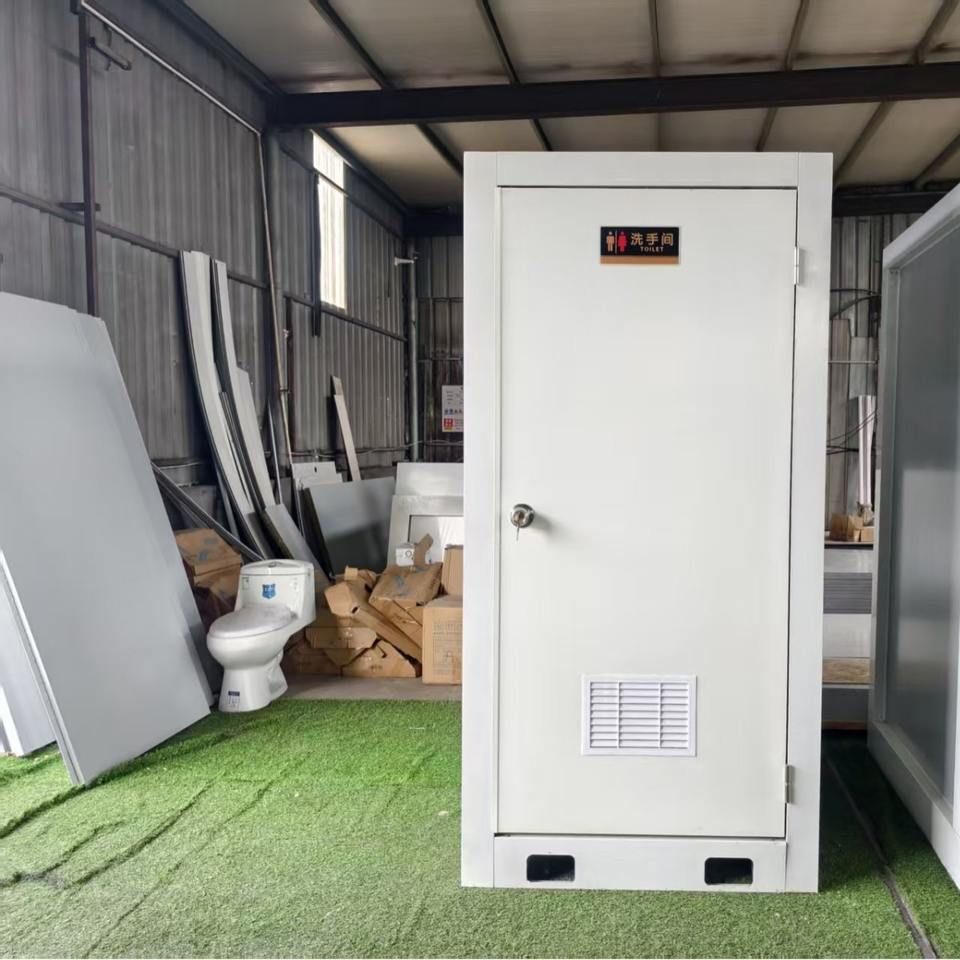
Structural Composition and Working Principle
The outdoor fecal storage box portable toilet typically consists of components such as a fecal and sewage storage tank (fecal storage box), floor slab, sanitary fixtures, walls, roof, and a mobile device. The fecal storage box is often located at the top or back, made of materials like color-coated steel, with a small door at the back for easy insertion and removal of the fecal tank. Its working principle falls into two categories:
- Waterless flushing and suction type: It relies on the fecal storage box to directly collect excreta without water flushing. When full, the fecal tank is cleaned manually or with a suction device.
- Dry packing type: It uses biodegradable packaging bags to wrap feces, with the fecal storage box serving only as a temporary storage container. When cleaning, the packaging bag is simply replaced.
Types and Sewage Treatment Methods
According to the sewage treatment method, portable toilets can be classified into the following types:
- Water flushing and waterless flushing and suction types: The former requires a water connection, using water flow to flush excreta into the fecal storage box; the latter relies entirely on the fecal storage box for collection without a flushing process.
- Recirculating water flushing type: Equipped with a sewage treatment device, it purifies the flushing water for recirculation, reducing water consumption. However, the fecal storage box may be used to store the treated residue.
- Dry packing type: As mentioned earlier, it isolates feces with packaging bags, with the fecal storage box serving only as a container, suitable for water-scarce environments.
Advantages and Application Scenarios
Advantages:
- Mobility: It adopts a steel structural main frame with a mobile device (such as wheels), allowing for quick disassembly, transportation, and reassembly.
- Economic durability: The exterior wall materials are selected from galvanized steel sheets, stainless steel sheets, etc., with internal thermal insulation treatment. The floor is laid with anti-slip flooring and a waterproof layer, adapting to harsh outdoor environments.
- Environmental protection and ecology: It does not require a fixed sewage discharge pipeline, reducing damage to the land, especially suitable for areas lacking infrastructure.
Application scenarios:
- Temporary venues: Such as large construction sites, squares, and exhibition venues that require short-term concentrated use of sanitation facilities.
- Mobile venues: Stations, docks, and tourist attractions with high pedestrian traffic and fixed locations.
- Water-scarce or sewage-free environments: Remote areas and post-disaster reconstruction areas that cannot be connected to the municipal sewage network can serve as alternative solutions.
Design Principles and Material Selection
The design follows the principles of mobility, economic durability, and environmental protection and ecology, with an overall lightweight and sturdy structure. The main frame is primarily made of steel structure, with exterior wall materials that balance strength and corrosion resistance (such as galvanized steel sheets). The interior enhances comfort and service life through thermal insulation and waterproof layers.



