Mobile Toilets for Outdoor Construction Sites and Scenic Areas
Mobile toilets for outdoor construction sites and scenic areas are facilities that can be moved as a whole and placed in fixed or temporary locations to provide toilet services for the public and customers.
I. Basic Composition Mobile toilets typically consist of core components such as fecal sewage storage tanks (or disposal units), floor slabs, sanitary ware, walls, washing equipment, water tanks, roofs, and mobile devices. Among them, the fecal treatment system is crucial. Depending on technological differences, it can be classified into water-flush types, waterless suction types, circulating water-flush types, and dry-pack types. For example, water-flush types require matching water tanks and sewage pipes, while waterless types rely on sealed storage tanks for regular cleaning. Circulating water-flush types achieve water reuse through biodegradation technology, and dry-pack types directly collect feces and replace packaging bags.
II. Structural Classification
- By structural form: They are divided into single-unit structures and composite structures. Single-unit structures are mostly independent units suitable for small-scale needs; composite structures are composed of multiple modules and can flexibly expand the number of toilet stalls, such as the common four-stall combined toilets in scenic areas.
- By mobility method: They are divided into lifting and handling types and powered towing types. The former relies on lifting equipment for short-distance transfer; the latter is equipped with a power system or towing device and can be transported over long distances by vehicles.
- By sewage treatment method: Water-flush types rely on water for flushing and require matching sewage pipes; waterless suction types use vacuum pumps to suck feces into storage tanks; circulating water-flush types use biological membranes or chemical agents to purify sewage; dry-pack types are completely waterless and collect feces in biodegradable packaging bags.
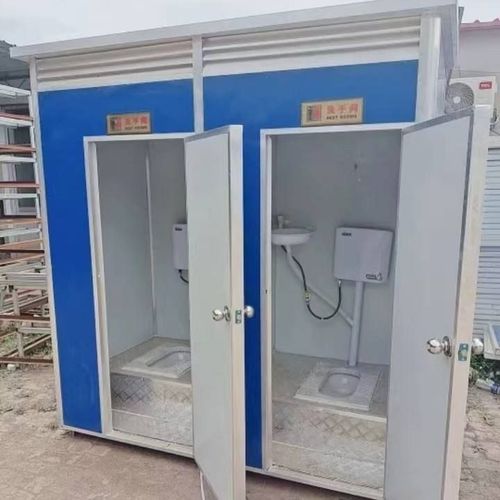
III. Application Scenarios and Advantages Mobile toilets are widely used in outdoor construction sites, scenic areas, temporary events, and other scenarios. For example, Dezhou Hongtu Metal Products Co., Ltd. once customized a mobile toilet for a factory in Zhejiang, adjusting the number of toilet stalls according to the male-to-female ratio (7 male stalls and 1 female stall) and completing the urgent project in 4 days. Scenic area campsites often adopt four-stall pointed-roof designs with exterior walls made of thermal-insulating metal carved panels, balancing practicality and aesthetics. Their core advantage lies in mobility, allowing rapid deployment to areas without fixed toilets and supporting repeated disassembly and reuse, significantly reducing long-term construction costs. Additionally, modular design allows flexible combination according to needs. For example, gender-separated toilets use galvanized steel frame structures with color-blocked exterior walls to enhance visual appeal, and the internal public areas are paved with waterproof green tiles for increased durability.
IV. Technical Features The design of mobile toilets emphasizes lightweight and durability, such as using metal carved panels or galvanized steel frames as exterior wall materials, ensuring structural strength while providing thermal insulation and waterproofing functions. The pointed-roof design effectively drains water and prevents snow accumulation, adapting to various climatic conditions. The internal configuration focuses on user-friendliness, such as installing urinals and column basins to enhance the user experience.