Our Company's General Manager Zhao Xiangyang Interviewed by China Archives News for Glorious 70 Years
In May 2019, the Glorious 70 Years yearbook interview series—jointly organized by Shanghai Archives News, the Faces program team, and other partners—was held at Shanghai Tower. Our company's general manager Zhao Xiangyang took part in the interview and introduced to the media our company's development path, the challenges facing the prefabricated container industry, and our growth goals and competitive strengths.
— Interview transcript below:
Glorious 70 Years interview Q1: Please share a story of how you or your enterprise grew together with the Republic;
A1: Since the 18th National Congress of the CPC, General Secretary Xi Jinping has put forward and repeatedly stressed that "lucid waters and lush mountains are invaluable assets," elevating green environmental protection to an unprecedented policy height. Every industry has gained a deeper understanding of green practices and taken stronger action.
China's steel output accounts for 50% of global production, with overcapacity of more than $13,888,889. In developed countries such as the United States and Japan, steel used in steel-structure buildings already accounts for 30% of steel output, and steel-structure floor area exceeds 40% of total building area—while in China the share is still under 5%. China also has the world's largest housing-demand market, so conditions for developing prefabricated steel-structure buildings are uniquely favorable.
Our company is dedicated to prefabricated steel-structure buildings—a form of green building that answers national policy and follows the market trend toward environmental protection. Prefabricated steel buildings in China are still at an early stage, yet they naturally deliver "four savings and one environmental benefit": land saving, water saving, material saving, and energy saving in construction, plus no construction waste and no environmental pollution. They also raise safety and civilized construction standards, shorten build cycles, reduce dependence on labor, produce no construction waste, improve overall social returns, raise housing quality, and provide healthy, comfortable, efficient space—buildings that coexist with nature. That fits China's view of environmentally sound, green, sustainable development.
Take prefabricated buildings that use containers as modular carriers. Global container stock is about $5,555,556 TEU, with a service life of about 10 years, so roughly $416,667 TEU are retired each year. Container architecture is a new building type with only about 20 years of history; it entered wider public view only in the past decade. In the 1970s, British architect Nicholas proposed converting containers into habitable buildings, but the idea drew little attention then. Not until November 1987 did U.S. architect Phillip Clark file a legal technical patent for converting steel shipping containers into buildings; the patent was granted in August 1989, and container architecture gradually emerged. Worldwide, container projects keep growing in scale and complexity, and the architectural performance of the boxes keeps advancing. Their popularity rests on natural advantages:
As assembly modules, containers are recycled assets with low build cost,
Short construction cycles—about 80% prefabricated in the factory and assembled on site, greatly cutting labor,
Green and eco-friendly: energy, water, and material saving, with no construction waste,
Easy to assemble and convenient to transport,
Highly open space with growable, freely adjustable layouts and strong visual impact.
Large-scale container modular projects are also appearing—for example student housing at the University of Amsterdam, a container hotel in Hong Kong, Japan's Nakagin Capsule Tower, and one of the stadiums for the 2022 Qatar World Cup, all built with containers. In China, the newly completed Xiong'an Citizen Service Center in Beijing's Xiong'an New Area, a container creative office park in Shanghai's Baoshan District, a container commercial street market in Hongkou District, and Vanke and other developers' container sales centers have all appeared in succession.
I believe that as public awareness of prefabricated buildings and green environmental ideals grows stronger, factors such as approval and land policies still slow container architecture today—but architecture will become more inclusive, technological, and innovative, and forms of prefabricated buildings will grow ever more diverse.
Q2: Please introduce your enterprise and services to viewers at home;
A2: Our company is a new-type startup focused on R&D for prefabricated and pre-manufactured buildings. Our main products center on recycled containers—giving them a second life by converting them for habitation, commercial display, public amenities, and more.
Our service scope also covers urban cultural themed design—for example sports-themed towns, sports and entertainment theme parks, tourism resort planning, cultural-tourism homestay design, and commercial leisure districts—while the spatial carrier is realized through container modular design, such as scenic-area support facilities, brand touring exhibitions, commercial amenities, villa residences, and cultural and education facilities.
Our company's vision: we work at the crossroads of temporary and permanent architecture, continually seeking to push conceptual boundaries and the potential of the unassuming container as a building material of the future—that is the mission of everyone at our company!
Q3: What opportunity first led you to choose and enter this industry;
A3: Our team has been building the business for five years. The parent company, Shanghai Jianmai Media, mainly focuses on commercial brand mobile touring exhibitions, marketing planning, and event execution—mobile advertising vehicles, caravans, display vehicles, mobile container showrooms, and agency planning for brand owners' mobile marketing campaigns.
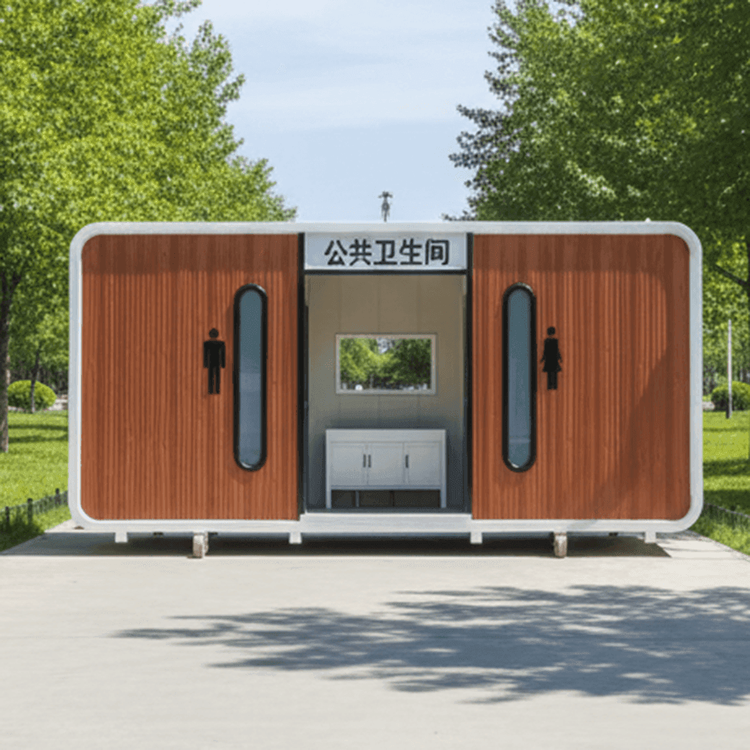
We truly entered the prefabricated building industry in 2018 through a major event: WIEE, the World Innovation and Entrepreneurship Expo, held on the Tongji University campus. With a short build window, limited budget, a ban on construction waste pollution and even construction noise on campus, and a need to fit the innovation-expo theme, we used 110 containers in an innovative modular design with an industrial display style that met the client's value and use needs well. We also delivered container commercial facilities for mid-to-large tourism resorts (retail markets, reception desks, landmark totems, gatehouses, public washrooms, and more) as well as homestay hotels. That opportunity led us to study the industry in depth, research the global market, and finally commit to green prefabricated buildings. At first we were optimistic about the outlook; then we truly wanted to unlock the team's full potential for something that does not damage the natural environment, produces no waste, makes full use of resources nature provides, stays closer to nature and ecology, and truly realizes "ecology first, green development." We keep working on practical ecological and environmental delivery and green low-carbon operations—across commerce, living, and public resources.
Q4: What products and services can the company offer clients at this stage;
A4: Our company builds on prefabricated modules and container combo buildings as the industrial base. With the dual safeguards of a strong team and differentiated creative technology, we serve the full industry chain of container-building design R&D, product construction, and project operations.
We already have a relatively complete container architectural design team and a modern container manufacturing plant, forming a one-stop service system of design R&D, factory fabrication, packing and transport, on-site installation, maintenance and upgrades, system build-out, and joint marketing.
Current business covers urban cultural themed design, container modular applications, and more.
Q5: As market demand evolves, what is your enterprise's core competitiveness or advantage;
A5: Our company's core competitiveness is, first, a maker-style design team, and second, product technology R&D. Team members are industry elites from institutions such as the Academy of Arts & Design, Tsinghua University, and Tongji University—spanning the 1970s, 1980s, and 1990s generations. Those born in the 1970s excel at management, the 1980s at experience, and the 1990s at creative differentiation and innovation. Different age groups work across departments and collaborate so that every project balances steadiness and innovation. Technically, our company holds distinctive advantages in prefabricated buildings; we continually absorb advanced practices from abroad while designers and engineers focus on developing our own core technologies.
We also pursue a brand strategy that emphasizes technical design, quality control, material safety, and construction safety—delivering modern architectural aesthetics and a humanistic experience for clients.
Q6: As a company leader, what plans do you have for the next three to five years;
A6: With environmental ideals first and advanced technology as the driver, we hope to find breakthroughs that help clear current policy and market barriers. Over the next three to five years we will pursue three breakthroughs: first, core technology—launch advanced prefabricated modular products and deliver modern modular building projects; second, market recognition—raise awareness and reputation for container modular products, push industry standards and approval policies forward, and build our company's container modular building brand; third, respond to the Party's call and, based on our own strength, better advance policy progress and the company's capital operations!
Q7: What changes do you hope this event and CCTV exposure will bring to enterprise development;
A7: First, help viewers understand the concept of the prefabricated building industry and the relatively new idea of container modular buildings, strengthen environmental awareness in the green building sector, and make the concept and benefits of container modular applications more acceptable.
Second, through this CCTV-related activity, let more people know that a team like ours at our company is doing this work—work with a broad outlook that still faces policy limits and other difficulties. We know its benefits for the environment, ecology, and green protection, and we know real market demand is huge, so we will keep running on this path.

Address: No. 1777 Hualong Road, Shanghai
Website: www.ourcompany.com
Phone: 021-60760737
Mobile: 13681880835/17721310336/13331815891
Email: marketing@ourcompany.com
24H premium customer service hotline: 400-716-6557